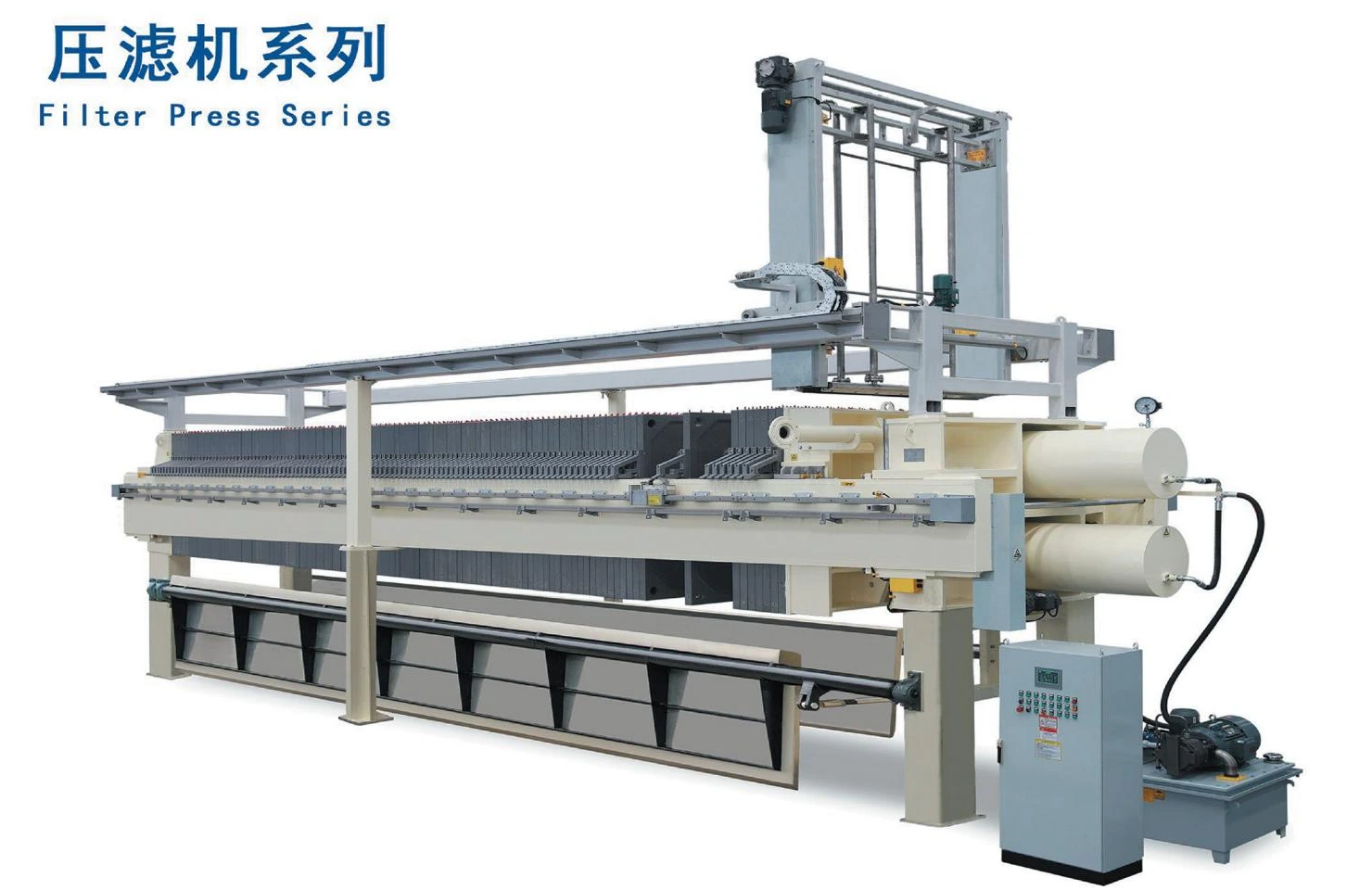
- 01Feed slurry→
- 02Form filter cake→
- 03Collect initial filtrate→
- 04Introduce approved wash liquid→
- 05Collect wash fraction→
- 06Isolate and depressurize→
- 07Open and discharge cake
The exact route, stages, pressure conditions, and fraction collection are application-specific. Filtration, washing, membrane squeezing, air displacement, and drying are separate steps and must not be combined into an assumed default cycle.
When to Choose This Filter Press
Choose a cake washing arrangement when ordinary filtration leaves a retained liquid that must be displaced, recovered, or reduced before unloading. Typical decision drivers include product recovery, removal of soluble impurities, controlled mother-liquor separation, or a need to collect first filtrate and wash liquor in different destinations. Washing is a process step, not a guarantee of a particular purity, moisture, or yield; the result depends on cake structure, liquid properties, wash direction, flow distribution, and test conditions.
The press is a better fit when the customer can define the liquid to be recovered or displaced and can provide representative slurry for confirmation. It may not be the right first choice where the cake is highly permeable and washing is unnecessary, where the solids bridge or crack unpredictably, or where the process actually requires thermal drying rather than liquid displacement. Filtration, cake washing, air displacement, and drying are separate operations and should not be treated as one default cycle.
- Use for a formed cake that must receive a controlled wash liquid through the plate pack.
- Define whether the priority is product recovery, impurity removal, mother-liquor displacement, or a separated wash stream.
- Confirm whether washing is one-stage or staged, and whether first filtrate, wash liquor, and final rinse need separate collection.
- Keep automatic operation and membrane squeezing as independent configuration decisions; either can be reviewed when the process requires it.
- Request testing when cake permeability, wash uniformity, solids loss, or the target liquid quality is uncertain.
| Decision point | What to confirm before selection |
|---|---|
| Process objective | Recovery, displacement, impurity removal, or another documented washing objective |
| Cake behavior | Expected thickness, permeability, cracking tendency, and whether the cake remains stable during washing |
| Liquid routing | Separate destinations for feed filtrate, wash liquor, rinse, and any recycle stream |
| Materials | Chemical compatibility, temperature, pH, and the wetted materials required |
| Evidence | Representative slurry, wash liquid, and a defined test method when performance is not yet known |
How It Works
The plate pack closes to form chambers lined with filter cloth. Feed slurry enters the press; liquid passes through the cloth and internal channels while solids accumulate as a cake. Once the filtration stage is complete, the selected wash circuit introduces wash liquid through the appropriate inlet path. The liquid travels through the cake and exits through a defined outlet path. Valves and piping determine which stream is collected at each stage.
A practical sequence is established only after the plate design, cloth pattern, cake thickness, feed properties, and wash objective are reviewed. A displacement wash may use a controlled flow path through the cake, while a different arrangement may be required for a more complex staged collection plan. Optional membrane squeezing can change the cake condition before or after washing, but it is not the same as washing. Air displacement, if specified, is also a separate step with its own safety and control requirements.
After washing, the press must be depressurized and isolated before opening. The cake is discharged, and the cloth and plate sealing surfaces are checked. Wash-water quantity, flow, contact time, direction, and sampling points should be recorded during trials or commissioning rather than assumed from a catalogue description.
- Close and seal the plate pack, verify the approved operating condition, then begin feed filtration.
- Collect and identify the initial filtrate before directing the intended wash stream to its specified destination.
- Introduce wash liquid through the confirmed wash inlet and monitor flow, pressure, sample points, and outlet routing.
- Stop, isolate, and release pressure according to the approved procedure before opening and unloading.
- Record cake condition, wash samples, filtrate clarity, and any solids carry-over for the next selection decision.
Main Components
The core assembly is a recessed or otherwise compatible plate pack, matching filter cloths, a closing system, a feed connection, internal filtrate channels, and a frame capable of supporting the selected arrangement. Cake washing adds wash ports, manifolds, valves, gaskets, and collection lines that must align with the plate hole pattern. The correct configuration is defined by the actual plate drawing and process route, not by the press name alone.
A wash circuit should make the flow path understandable to operators. Marking feed filtrate, wash liquor, rinse, and recycle or waste lines helps prevent cross-connection. Where separate fractions matter, collection valves and sampling points should be identified on the process drawing. A hydraulic power unit, electrical control panel, pumps, instruments, and optional automatic plate movement may be included after the duty and site interfaces are confirmed.
| Component or interface | Function and selection question |
|---|---|
| Filter plates | Create chambers and wash paths; confirm size, thickness, recess, hole pattern, sealing face, and material |
| Filter cloths | Retain solids and distribute liquid; confirm fabric, attachment, seams, openings, and chemical conditions |
| Wash manifold | Delivers the approved wash route; confirm inlet location, stages, valves, drains, and access |
| Collection piping | Keeps fractions separate; confirm outlet identification, sampling, routing, and downstream capacity |
| Closing and controls | Maintain the plate pack in the approved operating state; define operator tasks, interlocks, and alarms |
| Feed and wash pumps | Match the confirmed liquid duty; review compatibility, control range, and protection with the supplier |
Technical Specifications
The available digital filter plate series is identified in the supplied material as 250–2000 mm, with 1000 mm and 1250 mm examples. These references describe a product range and examples, not a promise that every size, plate type, or washing layout is suitable for every press. The final specification must be confirmed from the selected plate drawing, slurry test, required wash route, and site conditions.
Do not use filtration area as a direct production promise. Wet feed quantity, dry-solids loading, chamber volume, cake thickness, cycle time, filtrate quality, and wash result are different measurements. Feed pressure, any membrane squeezing pressure, and hydraulic closing-system pressure are also different values. Shengqi will confirm applicable values for the proposed model after receiving the selection data.
| Specification item | Confirmed basis or selection status |
|---|---|
| Plate size range reference | 250–2000 mm series reference; exact size and plate type require model confirmation |
| Illustrative sizes | 1000 mm and 1250 mm examples; examples are not a universal performance claim |
| Plate material | Select against slurry chemistry, wash liquid, temperature, and mechanical duty |
| Wash arrangement | Confirm direction, stages, ports, valves, collection fractions, and sample points |
| Operating pressures | Confirm feed, squeeze if used, and hydraulic closing values separately for the selected design |
| Capacity and moisture | Determine from slurry testing and cycle definition; no fixed value is stated here |
| Automation | Confirm required plate movement, valve sequence, instrumentation, alarms, and human checks |
Available Configurations
A cake washing press can be configured around the separation route rather than a generic accessory list. Options to review include compatible recessed or membrane plates, cloth attachment style, wash manifolds, divided collection, manual or automated valve operation, and an electrical control interface. A membrane plate can be considered when a defined squeeze stage is useful; it does not remove the need to design the wash path. Automatic plate handling can reduce repetitive movement, but operators still verify isolation, visual condition, samples, and abnormal alarms.
For corrosive or warm duties, the wetted plate, cloth, gasket, valve, pipe, and instrument materials must be checked together. The proposed arrangement may also include a feed pump, wash pump, filtrate receiver, wash-liquid tank, instruments, cake conveyor, or cake breaker. These modules are selected from the process boundary and site layout, not assumed to be included in every press.
- Plate type and size: select from the confirmed 250–2000 mm range reference and the actual process drawing.
- Wash route: single or staged washing, forward or other approved flow path, divided outlets, and sample points.
- Control level: manual sequence, assisted valve control, or automatic sequence with defined operator confirmation.
- Pressing stage: filtration only, or filtration with a separately specified membrane squeeze step.
- Site modules: feed and wash pumps, tanks, pipework, filtrate handling, cake discharge, and guarding as required.
Slurry Data Needed for Selection
Selection should start with a material balance and a clear washing objective. Please describe the wet feed rate with its unit and the dry-solids rate separately; they are not interchangeable. Include particle-size information or a representative sample where available, because fine or compressible solids can change cake permeability and wash behavior. If the target concerns filtrate clarity, product recovery, dissolved material, or a downstream water requirement, state the measurement and acceptance method.
A test request should identify the feed slurry and wash liquid, the proposed temperature and pH range, any hazardous or reactive constituents, and the intended operating schedule. Provide samples that represent normal and difficult conditions when variability is significant. Test results should state the plate, cloth, cake thickness, flow direction, wash amount, contact time, pressure stages, sample locations, and laboratory method.
| Data group | Information to send |
|---|---|
| Feed quantity | Wet slurry rate and dry-solids rate, each with unit; batch or continuous duty |
| Solids | Concentration, particle-size description, density if known, compressibility, and abrasive behavior |
| Liquids | pH, temperature, viscosity or notable rheology, chemistry, and wash-liquid identity |
| Performance target | Cake handling, filtrate or product recovery target, wash endpoint, and sampling method |
| Cycle | Hours per day, batches, allowable cycle stages, and whether separate fractions are required |
| Site | Power, available water or wash liquid, drainage, floor plan, altitude or ambient limits, and country |
| Evidence | Representative sample, existing press details, drawings, photos, and prior test observations |
Installation Requirements
Prepare a level support area with enough length to open the plate pack, remove cloths, inspect seals, and handle cake safely. Leave access around the press for valve and instrument checks; do not size the room only around the closed frame. The layout should show feed, wash, filtrate, drain, overflow, and collection lines with their destinations. Verify that the floor, lifting method, and local guarding plan support the selected equipment and maintenance tasks.
Before delivery, confirm electrical supply, control voltage, pump interfaces, wash-liquid storage, pipe sizes, drainage, ventilation, and any site-specific safety requirements. The customer and installer should agree who supplies foundations, cabling, pipe supports, tanks, downstream cake handling, commissioning liquid, and disposal arrangements. Do not connect an unverified wash route or operate a new sequence until the approved drawings, interlocks, isolation points, and operator instructions are available.
- Issue a general-arrangement drawing with opening travel, maintenance clearance, lifting access, and discharge space.
- Mark every feed, wash, filtrate, rinse, drain, and collection connection and verify its destination.
- Confirm utility points and responsibilities for power, water or wash liquid, drainage, air if used, and lifting.
- Complete guards, emergency stops, pressure-release and isolation procedures, and control checks before operation.
- Run a supervised commissioning sequence with samples and records; treat the result as a validation step, not a guaranteed catalogue value.
Maintenance & Replacement Parts
After each cycle, operators should check that the cake has discharged, the cloth surfaces are not blinded or torn, the plate sealing faces are clean, and the wash outlets are routed correctly. Filter cloth cleaning is not the same as filter-cake washing: cloth cleaning protects filtration performance, while cake washing treats the formed solids during a process stage. Use an approved cleaning method for the actual cloth, plate, gasket, and contamination; do not apply a generic chemical recipe without material and slurry review.
Planned maintenance includes inspection of cloths, plate seals, wash gaskets, valves, hoses, manifolds, pumps, pressure instruments, hydraulic components, fasteners, and control devices. Replacement cloths or plates must be matched to the existing equipment. Send the equipment nameplate, front and back plate photos, side and handle details, length, width, thickness, chamber depth, feed and outlet hole positions, sealing arrangement, puller or handle details, squeeze interfaces, material, and operating conditions before ordering.
- Isolate, depressurize, drain, and make the equipment safe before opening or maintenance; never open a press under pressure.
- Do not perform electrical work while energized and never bypass an interlock or safety device.
- Inspect wash holes and manifolds for blockage, but use a material-approved cleaning method and documented lockout procedure.
- Record cloth orientation, attachment, wear location, leakage, cake release, and wash sample observations.
- For replacement parts, compare drawings and photos with the proposed part before batch supply.
Frequently Asked Questions
Does a cake washing filter press wash the filter cloth?
No. Cake washing introduces liquid through the formed cake as a process step. Cloth washing or cleaning is a separate maintenance operation with its own compatibility and safety review.
Can cake washing and membrane squeezing be used on the same press?
They can be reviewed as separate stages when the selected plate, cloth, piping, controls, and slurry support them. Membrane squeezing changes cake condition; it does not replace a designed wash route.
Can you state the washing flow rate or final cake moisture from the plate size?
No. Plate size alone cannot establish wash flow, cycle time, filtrate quality, or cake moisture. These require the slurry, wash liquid, cake thickness, pressure stages, and test method to be confirmed.
Will the 250–2000 mm plate series fit every cake washing model?
The series is a confirmed range reference, with 1000 mm and 1250 mm examples. Exact applicability depends on the selected machine, plate drawing, wash ports, materials, and duty; Shengqi confirms the model during selection.
What should be collected separately during washing?
The process may require separate collection of initial filtrate, wash liquor, final rinse, recycle, or waste. The required fractions and destinations should be specified before the manifold and valve arrangement is approved.
What information should I send for a cake washing quotation?
Send the slurry and dry-solids rates with units, material description, pH, temperature, target, wash-liquid details, cycle schedule, site utilities, photos or drawings of an existing press, and representative samples if testing is needed.