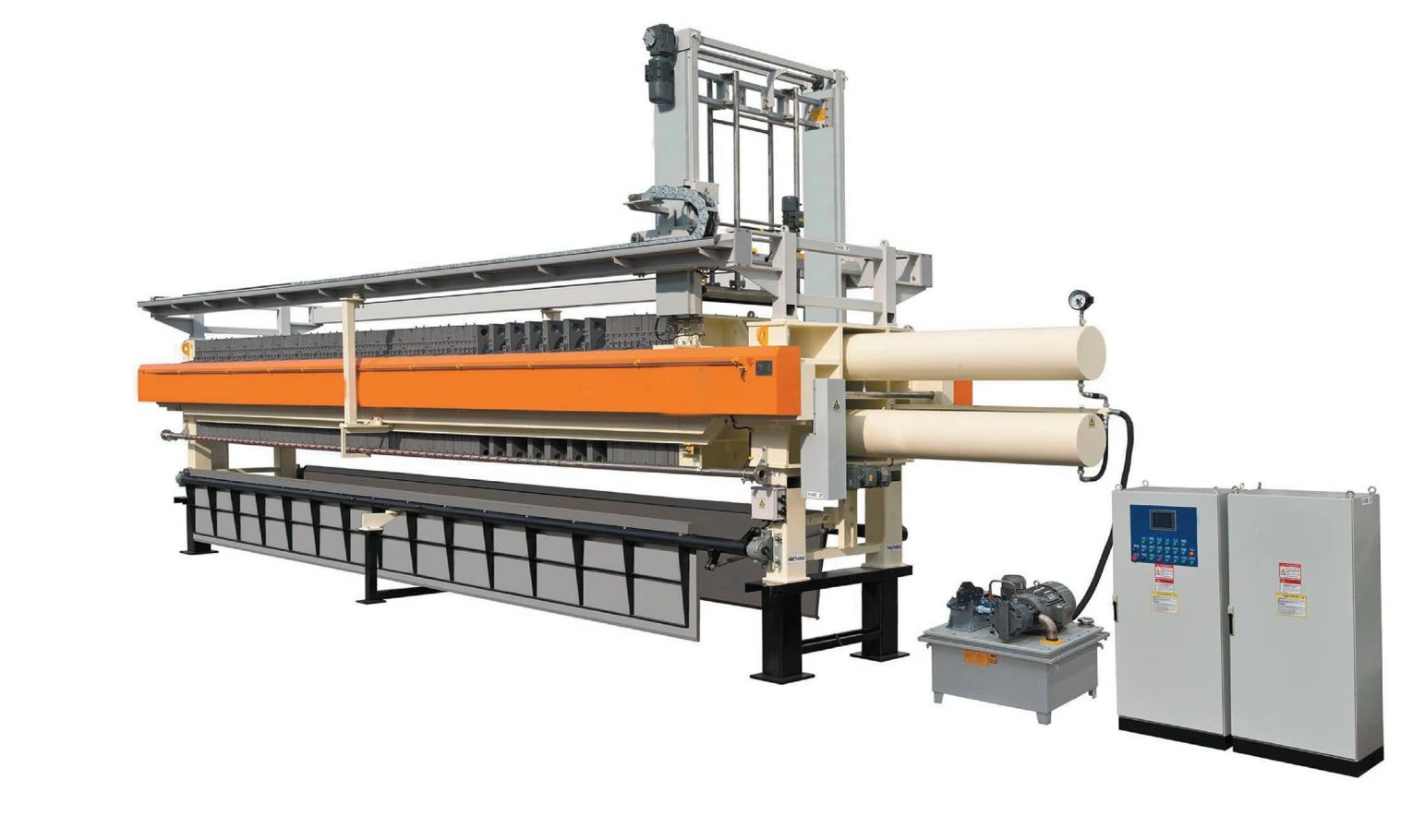
- 01Prepare and close plate pack→
- 02Feed slurry and collect filtrate→
- 03Confirm end of filling→
- 04Apply controlled membrane squeeze→
- 05Relieve membrane service→
- 06Open, discharge and inspect
Filtration, membrane squeezing, cake washing and cloth washing are separate operations. The approved model sequence must define each isolation, pressure limit and operator check; never open the press under pressure.
When to Choose This Filter Press
Choose a membrane filter press when the process needs a separate squeeze stage after the chambers have filled. Flexible membrane faces move into the cake space when the selected squeeze medium is admitted, compressing the formed cake and displacing additional liquid through the filter cloth. This arrangement can be useful where cake release, cake thickness, downstream handling or a repeatable pressure sequence is important.
A membrane press is not automatically the right choice because a slurry is difficult to filter. Fine particles, compressible solids, sticky cakes, rapid cloth blinding, abrasive solids and unstable feed concentration still require testing or careful review. A membrane unit also does not replace thermal drying, clarification equipment or a treatment process that establishes final water quality. The press separates solids and liquid; the project team must define what happens to both streams.
The membrane function and automatic operation are separate decisions. A membrane press may be supplied with manual, semi-automatic or automatic operating functions, while an automatic press may or may not include membrane plates. Select the structure from the dewatering objective, then define the required control and handling level.
- Consider it for a process that needs filtration followed by controlled cake squeezing rather than filtration alone.
- Confirm whether the cake must retain shape for conveyor, breaker, packaging or further processing.
- Review whether the slurry contains particles or temperatures that are compatible with the proposed membrane and cloth materials.
- Do not use a membrane stage to claim a fixed moisture result without a representative test and agreed operating conditions.
| Decision question | Information to confirm |
|---|---|
| What is the process objective? | Liquid-solid separation, cake handling, product recovery or a combination |
| Why is squeezing required? | Cake release, thickness control, downstream handling or additional mechanical dewatering |
| What can limit the cycle? | Fine solids, compressibility, viscosity, cloth blinding, abrasion or temperature |
| What must not be assumed? | Fixed capacity, pressure, cake moisture, service life or delivery time |
How a Membrane Filter Press Works
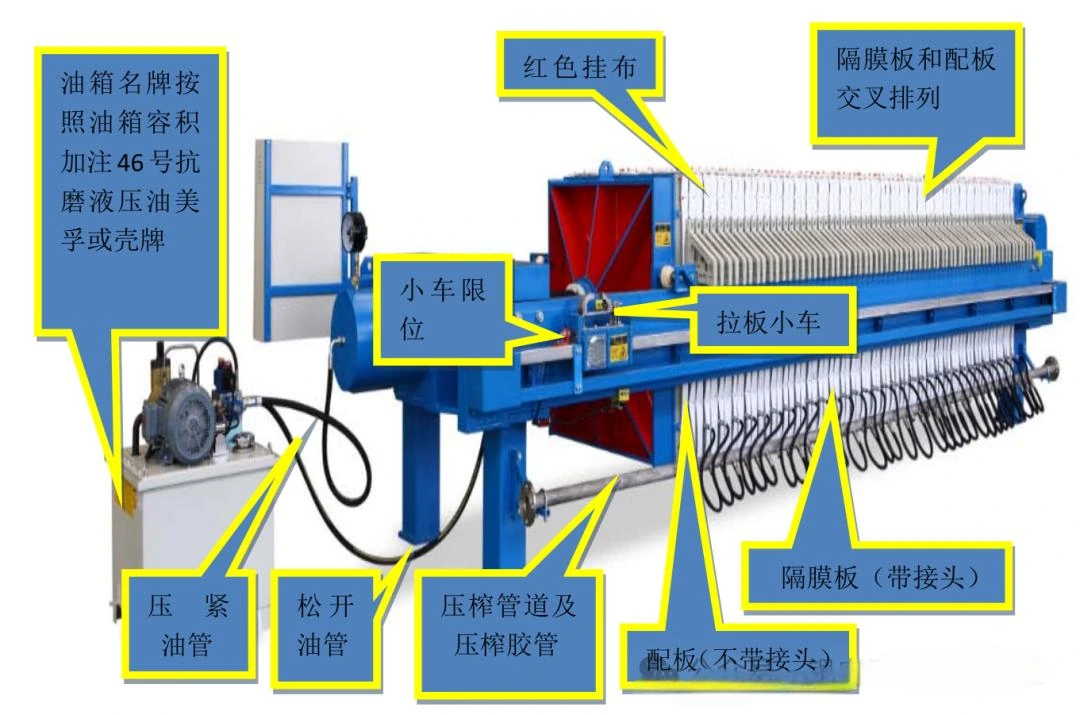
The press closes a pack of recessed or other compatible filter plates with cloths between adjacent faces. During feeding, slurry enters the feed channel and flows into the chambers. Liquid passes through the cloth and internal plate drainage paths to the filtrate outlet, while solids accumulate as a cake. The feed stage ends according to the selected process signal, such as a pressure trend, flow condition, time limit or operator decision; the exact control method must be confirmed for the model.
After filtration, the membrane stage is enabled as a separate operation. A compatible liquid or gas service acts on the rear side of the flexible membrane, causing the membrane to advance into the cake space. The cake is compressed against the cloth and more liquid leaves through the plate drainage route. The squeezing medium, pressure limit, hold time and sequence are application-specific. They must not be confused with slurry feed pressure or the hydraulic pressure used to close the plate pack.
When the cycle is complete, the membrane service is isolated and safely relieved according to the equipment procedure. Filtrate paths are checked for abnormal flow before the pack is opened. Plates are separated and the cake is discharged. Cloth washing, if required, is a separate cleaning operation; cake washing, if required, is a separate process step with its own liquid routing and collection.
- Feed: fill the chambers while filtrate travels through cloth and plate channels.
- Transition: stop or reduce feed according to the confirmed cycle logic.
- Squeeze: admit the selected membrane medium under the approved limit and sequence.
- Relieve: isolate and release the membrane service before opening the press.
- Discharge and clean: open the pack, remove cake, inspect cloths and wash only through the planned circuit.
Main Components and What They Do
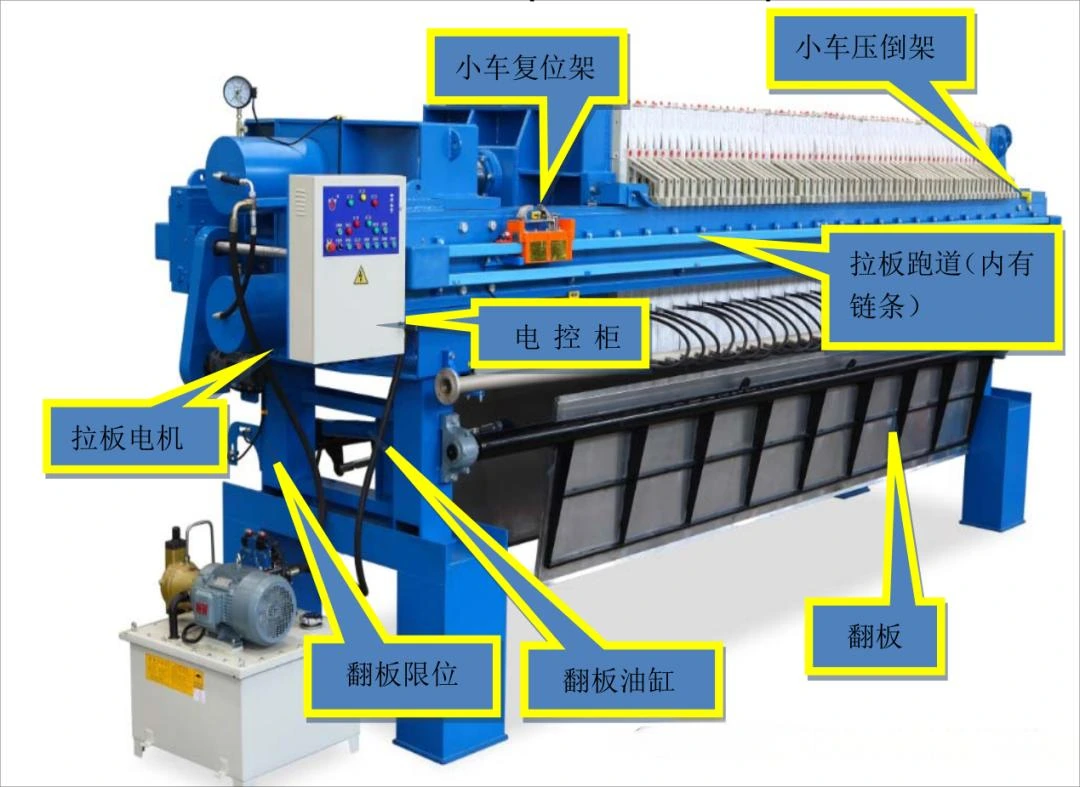
The plate pack provides the chambers, membrane surfaces, filtrate drainage and sealing interfaces. Recessed plates with membrane elements are common configurations, but the final plate design, dimensions, port arrangement and material must follow the selected model and slurry. Filter cloths create the separation surface and also affect filling, filtrate clarity, cake release and cleaning requirements.
Controls can monitor the cycle and interlocks can restrict unsafe movement. Automation can reduce repetitive operator actions, but it does not remove the need to confirm isolation, inspect the cloth and verify that the cake has discharged. The equipment drawing and quotation should identify the included scope rather than treating every pictured component as standard.
| Component | Function and selection check |
|---|---|
| Membrane filter plate | Moves into the cake space during the separate squeeze stage; confirm material, dimensions and service compatibility |
| Filter cloth | Retains solids and supports drainage; confirm weave, openings, fastening and chemical/temperature conditions |
| Hydraulic closing unit | Closes and seals the pack; do not confuse its hydraulic pressure with feed or squeeze pressure |
| Feed and filtrate manifolds | Direct slurry in and filtrate out; verify port positions, valves and collection routing |
| Membrane service circuit | Supplies and relieves the squeeze medium; confirm source, control limits and safe isolation |
| Control and interlocks | Sequence permitted actions and protect operators; confirm manual intervention boundaries |
Technical Specifications to Confirm
The confirmed reference material identifies a filter plate size series from 250 to 2000 mm and gives 1000 mm and 1250 mm examples. These references describe available examples in the supplied information; they are not a promise that every membrane press, plate arrangement or configuration is available at every size. The selected plate size, number of plates, chamber depth and membrane arrangement must be confirmed against the slurry and project requirements.
A useful specification review distinguishes geometric capacity from process performance. Filter area and chamber volume describe the plate pack; neither one alone proves a treatment rate. Wet slurry quantity is not the same as dry-solids loading. Feed pressure, membrane squeeze pressure and hydraulic closing pressure are three different values. Final values should appear in the approved technical offer and operating instructions after the material and utilities are reviewed.
| Specification field | Status and confirmation basis |
|---|---|
| Plate size series | 250–2000 mm series is identified; exact membrane model and selected size require confirmation |
| Examples | 1000 mm and 1250 mm examples are confirmed references, not universal model promises |
| Filter area and chamber volume | Calculate from the approved plate drawing and chamber arrangement; do not label either as capacity |
| Feed pressure | Confirm for the slurry, feed pump and approved operating sequence |
| Membrane squeeze pressure | Confirm by membrane material, service medium and equipment design; not the feed pressure |
| Hydraulic closing pressure | Confirm from the closing system and sealing design; not a process pressure claim |
| Cake moisture, throughput, service life and delivery | Require project-specific confirmation or test evidence; no fixed value is claimed here |
Available Configurations
A membrane press can be configured around the plate pack, cake discharge method and operating sequence. Options may include different plate materials, cloth attachment styles, feed and filtrate port arrangements, membrane service media, manual or automated plate movement, cloth washing provisions and local control interfaces. Availability is model-specific, so the selection conversation should begin with the slurry and the required cycle instead of a list of assumed accessories.
- Plate size and chamber depth selected from the approved drawing.
- Membrane material and service medium selected for temperature and chemical compatibility.
- Cloth material, weave, fastening and port pattern selected for the actual solids and filtrate objective.
- Manual, semi-automatic or automatic actions defined with the operator tasks that remain.
- Feed, filtrate, wash, membrane service and drain interfaces shown on the project layout.
- Spare cloths, gaskets, valves and other wear items listed against the confirmed model.
Slurry Data Needed for Selection
Selection is more reliable when the customer supplies a representative slurry description and operating target. Please state the source of the material and whether the sample represents normal, start-up and peak conditions. A single solids percentage without its basis can be misleading: identify whether it is by mass or volume, and provide wet slurry flow separately from dry-solids loading.
Also describe the liquid phase, particle size or settling behavior if known, viscosity, temperature, pH, abrasive or corrosive components, and any flocculant or conditioning already used. Explain whether the solids are a saleable product, waste, tailings, sludge or an intermediate. State the acceptable filtrate appearance or downstream requirement, but do not equate visual clarity with regulatory compliance without a defined test.
| Data group | Please provide |
|---|---|
| Material identity | Process source, solids type, normal/peak variation and whether solids are recovered or discarded |
| Loading | Wet slurry quantity with unit, dry-solids loading with basis, batch or continuous operation |
| Physical behavior | Particle size or settling notes, viscosity, compressibility, stickiness and abrasion |
| Chemistry | Liquid composition, pH, temperature and known compatibility restrictions |
| Target | Cake handling, filtrate destination, cycle preference and any washing or recovery requirement |
| Site limits | Available power, water, air or other membrane service, space and local safety requirements |
Installation Requirements
Before delivery, reserve a level support area that can carry the selected press and its operating loads. Allow clear access for plate opening, cloth inspection, cake removal, lifting and maintenance. The final layout should show the feed pump and pipework, filtrate collection, membrane service, drains, wash connections if applicable, electrical cabinet and the route for wet cake. Keep the operating side accessible; do not locate fixed obstructions where plates or cloths must be handled.
Operating personnel need instructions for the actual cycle: feed, transition, membrane squeeze, relief, opening, discharge and cleaning. Never open the plate pack while it is pressurized, and never perform electrical work while energized. Do not defeat an interlock to continue a cycle. Any abnormal pressure, leak, movement or control indication requires a controlled stop and qualified inspection.
- Confirm foundation, lifting route, maintenance clearance and cake discharge route from the approved layout.
- Provide independently supported feed, filtrate, membrane service, drain and wash connections.
- Verify power, earthing, control signals, isolation points and guarding before commissioning.
- Define operator training and the boundary between automatic sequence and manual inspection.
- Use a safe, depressurized and isolated state for opening, cleaning or maintenance.
Maintenance and Replacement Parts
Routine care begins with observing the cycle and inspecting the press after a safe stop. Check cloth seating, visible tears, blocked drainage areas, plate sealing surfaces, membrane condition, manifolds, valves and hydraulic leaks. Record unusual filtrate color, rising cycle time, uneven cake thickness or leakage because these signs can connect a cloth, plate, feed or control issue. Wash filter cloths using a method compatible with the material and cloth; do not apply a generic chemical recipe without confirming the cloth, plate, membrane, slurry residue and site safety requirements.
Before changing a membrane or cloth design, compare the drawing and sample with the actual press and run a controlled confirmation. Keep a record of the model, quantity, installation date and observed service condition. Replacement plates, membrane plates, polypropylene cloths and measurement guidance are available through the related pages below; the final match remains subject to drawing and application review.
| Observed need | First safe check |
|---|---|
| Leak at plate edges | Stop in the approved safe state, relieve pressure, isolate and inspect sealing surfaces, cloth seating and plate alignment |
| Longer cycle | Compare feed trend, solids condition, cloth permeability, chamber filling and control sequence |
| Poor cake release | Inspect cloth attachment, cake stickiness, membrane sequence and opening/discharge arrangement |
| Damaged membrane or cloth | Record model and service conditions; replace only with a reviewed material and matching geometry |
| Need to order a replacement | Send nameplate, dimensions, hole pattern, photos, sample information and quantity for review |
Frequently Asked Questions
What is the difference between feed pressure and membrane squeeze pressure?
Feed pressure moves slurry into the chambers during filling. Membrane squeeze pressure acts on the rear side of the flexible membrane after the cake has formed. Hydraulic closing pressure holds the plate pack closed. They are separate values and must be confirmed independently for the selected equipment.
Can a membrane press be automatic?
Yes, membrane function and automation are separate choices. The press can be specified with an appropriate control level, but automatic actions do not remove manual responsibilities such as inspection, safe isolation, cloth care and abnormal-condition response.
Which plate sizes are referenced for selection?
The supplied reference identifies a 250–2000 mm filter plate size series and gives 1000 mm and 1250 mm examples. These are reference points, not a claim that every size and membrane configuration is available for every model.
What should I send for a membrane plate or cloth quotation?
Send the equipment nameplate, clear front, back, side and handle photographs, dimensions, chamber depth, hole positions, sealing and pulling details, membrane ports, material, slurry conditions, quantity and any original cloth or plate sample information. A drawing can be reviewed before batch supply.
What safety limits apply during maintenance?
Do not open the pack under pressure, do not work on energized electrical equipment and do not bypass an interlock. Stop, isolate, relieve stored pressure, verify the safe state and use qualified personnel in accordance with the approved instructions.