- 01Define test objective→
- 02Describe and label slurry→
- 03Confirm plate, cloth and safe test setup→
- 04Run separated filtration stages→
- 05Record filtrate and cake observations→
- 06Review scale-up or replacement next step
Filtration, membrane squeezing, cake washing and thermal drying are different stages. Only include squeezing or washing when the agreed test protocol requires it; a laboratory observation does not establish production capacity or final water-quality compliance.
When to Choose This Filter Press
Choose a laboratory filter press when the key uncertainty is how a specific slurry behaves under a defined filtration sequence. It is useful for comparing cloth materials, observing cake formation, checking filtrate clarity, evaluating whether a chamber or membrane-style step deserves further review, and producing evidence for a larger press-sizing discussion. The useful result is a documented relationship between sample preparation, filtration conditions, cake condition and filtrate appearance.
A laboratory test is especially valuable when a small change in particle size, solids concentration, viscosity, temperature, pH or upstream thickening may change the outcome. It should be planned around the actual decision: screen a cloth, compare a cycle, estimate a test filtration rate, investigate a difficult material, or prepare a sample for engineering review. A short test cannot by itself establish production capacity, final cake moisture, service life, delivery time or a complete plant design.
The laboratory page belongs to equipment selection, while an application page defines the material and its process context. For an application-specific recommendation, provide the material history and the operating objective as well as the sample.
- Screening a filter cloth or a plate arrangement with a representative sample.
- Comparing filtrate clarity and cake release observations under recorded conditions.
- Checking whether a slurry is suitable for a later pilot or production sizing discussion.
- Separating filtration observations from later washing, squeezing or thermal drying decisions.
- Creating a test record that another engineer can review and repeat.
| Decision | Laboratory test contribution | Do not infer without further confirmation |
|---|---|---|
| Cloth selection | Compare candidate cloth construction, blinding tendency and release observations | A universal cloth recommendation for every batch |
| Filtration behavior | Record filtrate flow, time points and cake appearance | Production throughput or plant capacity |
| Plate arrangement | Observe sealing, feed and discharge behavior on the test setup | Compatibility with an unverified production frame |
| Cake handling | Record whether the test cake separates and how it feels when handled | A guaranteed final moisture or conveying result |
How a Laboratory Filter Press Works
The unit holds a defined filter area between plates and cloths. A prepared slurry enters the test filtration path, liquid passes through the cloth and supporting drainage surface, and suspended solids accumulate to form a cake. Filtrate is collected separately so its appearance and volume can be recorded. The test ends according to the agreed observation point, such as a time limit, a filtrate-flow change, a target cake condition or another documented criterion.
The operator should record the sequence rather than treating every step as one pressure number. Feed pressure, any separate squeeze pressure and the hydraulic system pressure are different items. If a test includes a compression or membrane step, record it as a distinct stage after the filtration observation. Cake washing is also a separate process step from washing the cloth. Thermal drying is not the same as mechanical dewatering and must not be claimed from a press-only test.
A useful test record links sample preparation to each observation: sample mass or volume, solids information, temperature, pH where relevant, cloth identification, plate identification, feed condition, time, pressure readings where available, filtrate appearance and cake description. Repeatability matters more than an isolated attractive result.
- Prepare and label the representative slurry sample.
- Install the identified plate and cloth arrangement and inspect sealing surfaces.
- Feed the sample using the agreed sequence while recording time and observations.
- Collect filtrate separately and record volume, appearance and any sample ID.
- Stop, isolate and make the equipment safe before opening or changing the setup.
- Record cake release, cake thickness or mass where the test method requires it.
- Compare the result with the stated decision, not with an assumed production promise.
Main Components
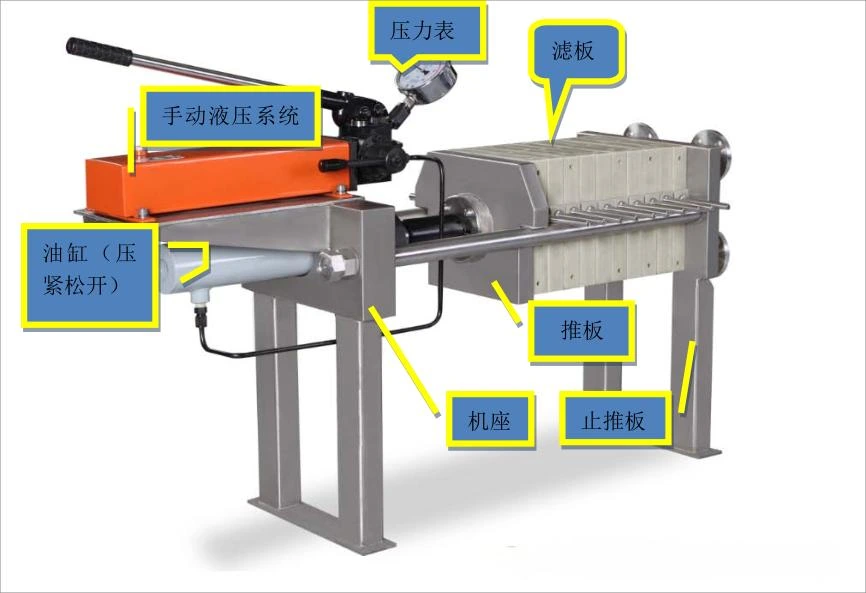
A laboratory filter press is a coordinated test assembly rather than only a small plate pack. The frame supports the test components; the plate and cloth define the filtration interface; the feed and filtrate connections define the fluid path; and the collection arrangement preserves the sample for observation. The exact arrangement must be confirmed against the proposed test method and the material's compatibility requirements.
The plate pack may use recessed or another agreed laboratory arrangement. A laboratory unit may be operated manually or with supporting equipment, but the control boundary should remain clear: automation can repeat a defined action, while the operator remains responsible for sample identity, visual checks, safe isolation, data recording and deciding whether the result is valid.
| Component or interface | Function in a test | Confirmation required |
|---|---|---|
| Frame and closing arrangement | Holds plates and maintains the test assembly | Dimensions, closing method and safe operating procedure |
| Filter plates | Create chambers, drainage paths and connection interfaces | Plate pattern, material, thickness and compatible test size |
| Filter cloths | Retain solids and control filtrate passage and cake release | Material, weave, attachment and sample-specific selection |
| Feed connection | Introduces the prepared slurry to the test path | Connection size, sample volume, feed method and compatibility |
| Filtrate collection | Keeps liquid available for measurement and inspection | Container arrangement, sampling method and overflow control |
| Pressure and observation points | Support a recorded test sequence | Which pressure is measured and when it is recorded |
Technical Specifications
The available brochure information confirms a filter-plate size series from 250 to 2000 mm and gives 1000 mm and 1250 mm examples. These references describe the documented range and examples; they are not a promise that every laboratory configuration or every production machine uses every size. Shengqi should confirm the applicable plate size, chamber depth, filtration area, feed arrangement and materials after reviewing the sample and test purpose.
For a laboratory unit, a meaningful specification is the complete test boundary. The plate size alone does not establish filtration area, chamber volume, actual capacity, cake moisture or scale-up performance. Those results depend on the material, preparation, cloth, cycle definition and measurement method.
| Specification item | Confirmed or selectable basis | Selection note |
|---|---|---|
| Documented plate size series | 250–2000 mm brochure series | Confirm the size applicable to the proposed laboratory or reference setup |
| Illustrative plate examples | 1000 mm and 1250 mm examples | Examples only; do not treat them as universal laboratory sizes |
| Filter area and chamber volume | To be calculated or confirmed for the selected plate and chamber | Do not substitute area or volume for production capacity |
| Pressure | To be defined by test stage and equipment arrangement | Separate feed, squeeze and hydraulic-system pressure |
| Materials of construction | To be matched to slurry, temperature and chemistry | Review wetted materials before a test |
| Filtrate and cake measurement | Method to be agreed before testing | Record units, sampling points and test end condition |
Available Configurations
Configuration should follow the test question. A cloth comparison may need quick and repeatable cloth identification; a filtration study may need a defined filtrate collection arrangement; a material-compatibility review may require specific wetted materials. A manual arrangement can be appropriate where the test operator needs direct observation. A controlled or automated arrangement can assist with repeatability, but it does not remove the need for manual checks or make the result automatically transferable to a production line.
Membrane and automatic functions are not mutually exclusive concepts. If a membrane squeeze stage is required, it must be specified as a separate stage and confirmed for the selected plates, membrane material and test method. If automation is requested, define which actions are controlled and which decisions remain with the operator. Do not add washing, squeezing or automatic discharge to the default test sequence without confirming the process objective.
- Plate and cloth arrangement selected for the sample and observation objective.
- Manual operation for direct visual control, or defined control functions for repeatability.
- Separate filtrate collection and sampling points where clarity or chemistry must be reviewed.
- Optional squeeze or washing stages only when the test protocol calls for them.
- Feed, support and safety interfaces confirmed with the laboratory site before shipment or installation.
Slurry Data Needed for Selection
A laboratory press should be selected from the test objective and material information, not from a plate number alone. Send the sample description and the operating context even when some values are unknown. “Not sure” is a useful selection answer if it is clearly identified and can be resolved during testing. A representative sample should be labeled with its origin, collection time and any preparation performed before dispatch.
The form should distinguish wet feed quantity from dry-solids quantity. It should also distinguish filtration pressure from any membrane squeeze pressure and from the hydraulic system pressure. If the project needs water reuse or a discharge decision, state that as a separate objective: a clear filtrate observation is not automatically proof of regulatory compliance or final water quality.
| Data field | What to provide | Why it matters |
|---|---|---|
| Material and origin | Process, source, variability and sample date | Shows whether the sample represents the intended feed |
| Wet feed and dry solids | Mass or volume with units, plus solids basis if known | Prevents a wet-load figure being mistaken for dry-solids loading |
| Particle and viscosity description | Available analysis, visual description or test notes | Helps anticipate settling, blinding and cake formation |
| Chemistry and temperature | pH, temperature and compatibility concerns where relevant | Guides wetted-material and cloth review |
| Test objective | Clarity, cake, cloth, cycle, wash or scale-up question | Defines what must be measured |
| Site constraints | Power, space, drainage, ventilation and operator conditions | Prevents an unsuitable laboratory arrangement |
Installation Requirements
Before installation, confirm a stable and level support area with enough access to load the sample, inspect the plate pack, collect filtrate and remove the test cake. The layout must leave a safe working boundary around moving or closing parts and must keep sample containers from obstructing the frame. Drainage and spill-control arrangements should be planned for the actual slurry rather than assumed from clean water testing.
Confirm the available electrical supply and any feed, air, hydraulic or water connections that the selected configuration actually requires. Utilities are site responsibilities unless a written scope assigns them differently. The commissioning discussion should cover operator training, test records, emergency stopping, isolation and the permitted sequence for opening the press. Never open a press while it is pressurized, never service energized equipment, and never bypass an interlock or protective device.
- Level support, clear access and a defined sample and filtrate collection area.
- Confirmed electrical and process utility requirements for the selected arrangement.
- Spill containment, drainage and cleaning provisions compatible with the slurry.
- Safe isolation and operator instructions available before testing.
- Hazard information and personal protective measures reviewed before sample handling.
Maintenance and Replacement Parts
After each test, follow the agreed safe isolation procedure, remove residual solids before they harden, inspect cloth seating and examine plate sealing surfaces. Cleaning the cloth is not the same as washing the cake: the first restores the filtration interface for another test, while the second is a process step intended to displace soluble material from a cake. Choose any cleaning method only after reviewing cloth, plate and slurry compatibility; do not use a generic chemical recipe.
Replacement requests should be based on evidence. For plates, provide the equipment nameplate, front and back photographs, side and handle details, length, width, thickness, chamber depth, feed and filtrate hole positions, sealing profile, puller arrangement, squeeze connection, material and operating conditions. For cloths, provide the installation form, center or corner holes, neck and edge construction, attachment method, dimensions, stitching details, original sample and the difference sought between an exact replacement and a performance change.
| Inspection | Record | Escalate when |
|---|---|---|
| Cloth and seams | ID, fit, tears, blinding and attachment | Damage, poor fit or repeatable leakage appears |
| Plate sealing face | Cleanliness, scratches, deformation and alignment | Sealing cannot be restored by safe cleaning and inspection |
| Connections | Hose, gasket, valve and collection condition | A connection leaks or is incompatible with the sample |
| Safety controls | Isolation, guard and interlock checks | Any control does not function as intended |
| Test record | Sample, sequence, pressure stage and observations | Results cannot be traced or repeated |
How to Turn a Test into a Selection Decision
A useful report states the question, sample identity, preparation, equipment arrangement, test sequence, measurements and limitations. Include raw observations rather than only a conclusion: filtrate volume at recorded times, visual clarity description, cake thickness or mass where measured, release behavior, cloth condition and any deviation from the planned sequence. When comparing two cloths, change one defined variable at a time where practical.
- Write the decision question before the test starts.
- Use consistent units and label every sample and cloth arrangement.
Frequently Asked Questions
Is a laboratory filter press the same as a production filter press?
No. It is configured to investigate a sample and support a selection decision. Production equipment must be sized and specified from representative material data, the required cycle, site utilities, safety conditions and a documented engineering review.
What plate sizes can be discussed?
The brochure confirms a filter-plate series from 250 to 2000 mm and gives 1000 mm and 1250 mm examples. The applicable laboratory arrangement must be confirmed; these references do not mean every laboratory unit uses every size or that a plate size proves capacity.
Can I use the test to promise a final cake moisture?
No. Cake condition depends on the material, solids basis, cloth, chamber, cycle and measurement method. A laboratory result can document an observed condition under stated test conditions, but it is not a universal moisture guarantee.
Can the unit test a membrane squeeze stage?
A membrane stage may be considered when it is part of the test question and the selected plate, membrane, pressure sequence and safety controls are confirmed. Filtration and squeezing must be recorded as separate stages.
Does an automatic laboratory unit remove the need for an operator?
No. Automation can repeat defined actions, but an operator still identifies samples, checks the assembly, observes the test, records data, verifies safe isolation and decides whether the result is valid.
What should I send before requesting a recommendation?
Send the material origin, sample condition, wet feed and dry-solids information if known, particle or viscosity notes, temperature, pH or compatibility concerns, test objective, desired measurements, site utilities and any plate, cloth or equipment photographs. Unknown fields may be marked Not Sure.
Can I open the press immediately after stopping the feed?
No. Follow the documented isolation and pressure-release procedure. Never open a press while it is pressurized, never service energized equipment and never bypass an interlock.