- 01Describe slurry and cake→
- 02Confirm test or selection data→
- 03Specify plate and cloth pack→
- 04Define fast-opening sequence→
- 05Review site interfaces→
- 06Filter, isolate and open safely→
- 07Discharge and inspect cake
Filtration, pressure release, optional squeezing or washing and cake discharge are separate stages. The opening sequence never authorises opening under pressure or bypassing a guard or interlock.
When to Choose This Filter Press
Choose a fast-opening arrangement when the press must separate a plate pack for repeated cake discharge and the site benefits from a consistent, visible opening sequence. It can be considered for mineral slurries, sand-washing sludge, stone wastewater solids, ceramic or kaolin materials and other applications where cake must be released, inspected or conveyed after filtration. The choice concerns unloading and cycle handling; it does not replace slurry testing or determine guaranteed capacity by itself.
A fast-opening press is not automatically the right answer for sticky, elastic or poorly formed cakes. Cake adhesion, cloth selection, feed behaviour and the need for washing may change the preferred arrangement. Automatic opening can be combined with other press structures, while a fast-opening mechanism may still require an operator to inspect cloths, confirm the cycle is complete and manage the discharge area. Before requesting a quotation, define whether the priority is shorter opening time, clearer cake access, reduced manual plate handling, inspection or integration with a conveyor or cake breaker. Never open a press while pressurised and never defeat a guard or interlock.
The practical boundary is simple: the mechanism may sequence movement, but trained personnel still verify process completion, zero pressure, safe isolation, cake release and abnormal leakage.
- Repeated cake discharge where a defined opening sequence is useful.
- Solids that form a removable cake under the proposed filtration conditions.
- A planned discharge zone, suitable access and a trained operating team.
- Slurry data or a representative filtration test.
- A review of plate size, chamber depth, cloth and discharge handling together.
| Decision question | Information to confirm |
|---|---|
| Why fast opening? | Cycle handling, inspection, labour boundary or downstream discharge requirement |
| What is the cake like? | Sticky, abrasive, fragile, oily, fibrous, free-draining or difficult to release |
| How will cake leave? | Gravity discharge, tray, conveyor, cake breaker or another defined route |
| What is the safety boundary? | Pressure fully relieved, energy isolated and interlocks functional before opening |
How It Works
The press holds a stack of recessed or otherwise specified filter plates between a fixed head and a moving head. Filter cloths create the separation surfaces. During feeding, slurry enters the feed channel and flows into chambers. Liquid passes through cloth and internal drainage paths to the filtrate outlet while suspended solids build cake in the chambers. Feed pressure, slurry concentration and permeability affect cake formation; they must not be confused with hydraulic closing pressure or a later squeeze step.
When filtration is complete, the feed and relevant valves are stopped according to the site procedure. Pressure is relieved and the isolation state is verified. The opening mechanism then separates plates in its defined sequence, exposing cakes for discharge. A plate may need visual inspection before the next movement. Controls can sequence motion, but the operator still confirms safe conditions, cake release and abnormal leakage. Washing, air blow, membrane squeezing and other optional stages are separate decisions, not one default cycle.
- Condition feed and confirm the discharge area is clear.
- Close and secure the plate pack; verify cloths, seals and connections.
- Feed slurry while observing filtrate clarity, leakage and pressure trend.
- Stop or change feed only under the approved valve and pump sequence.
- Relieve pressure and isolate energy before any opening movement.
- Open plates in the selected sequence; inspect release, cloths and plate faces.
- Remove cake, record abnormalities and reset the pack.
| Stage | Physical event | Check |
|---|---|---|
| Filtration | Liquid drains through cloth while solids accumulate | Feed condition, filtrate route and leakage |
| Pressure release | Stored process pressure is removed | Confirm zero pressure and isolation |
| Fast opening | Plate pack separates in a defined order | Guards, interlocks and discharge zone |
| Cake discharge | Cake falls or moves to the planned route | Release, cloth condition and foreign objects |
Main Components
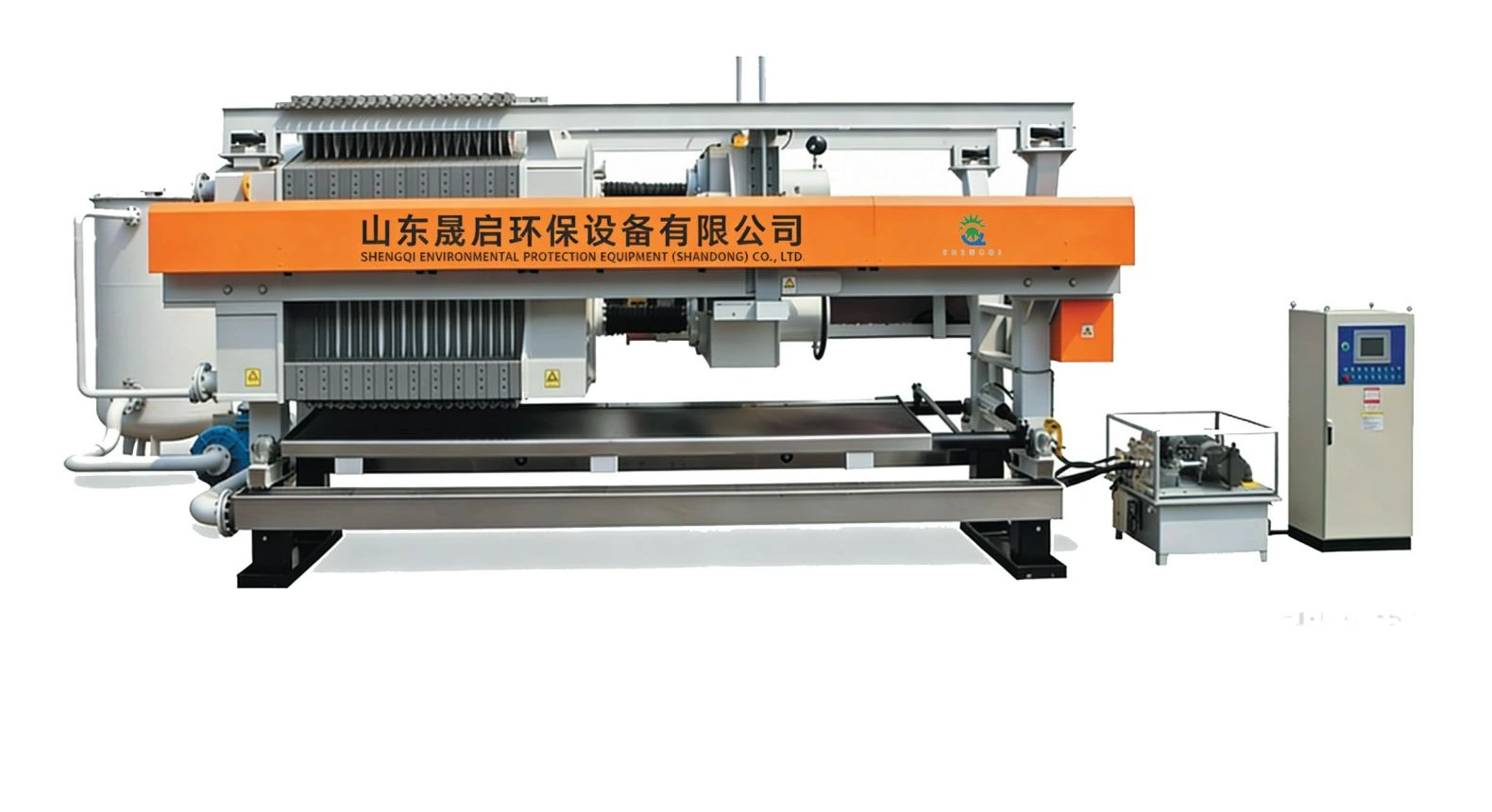
The frame supports fixed and moving heads, the plate pack and the opening mechanism. The hydraulic closing unit holds the pack; its hydraulic-system pressure is separate from slurry feed pressure and any membrane squeeze pressure. Feed channels, filtrate ports, manifolds and pipework are selected around the plate design and process route.
The fast-opening assembly may include a driven plate-moving arrangement, carriers, chains or other mechanical elements depending on the confirmed design. The exact mechanism, stroke, sequence and guarding must be confirmed on the equipment drawing. Do not infer these details from a photograph or nominal plate dimension. Filter plates and cloths are process-contact parts: material, sealing profile, thickness, recess and hole pattern must match the frame and slurry.
| Component | Function | Selection or inspection point |
|---|---|---|
| Frame and heads | Carry and align the plate pack | Foundation, alignment, access and corrosion environment |
| Hydraulic closing unit | Close and hold the pack | Electrical, hydraulic and safety interface |
| Filter plates | Form chambers and drainage paths | Material, size, thickness, recess, holes and seals |
| Filter cloths | Provide separation surface | Fabric, fit, tension, seams and cleaning method |
| Opening mechanism | Separate plates in sequence | Stroke, carriers, guarding, controls and manual boundary |
| Piping | Move slurry and filtrate | Connection size, valves and compatible materials |
Technical Specifications
Shengqi can discuss filter plate series from 250 to 2000 mm, with 1000 mm and 1250 mm examples confirmed in the available material. These are reference series ranges, not a statement that every fast-opening configuration is available at every size or that a size guarantees pressure, throughput, moisture, cycle time or service life. Final specification depends on plate design, material, opening arrangement, feed conditions and site requirements.
The following points are the technical basis for confirmation. Where a value is not established, it remains a selection item rather than an invented parameter.
| Specification item | What can be stated now | What must be confirmed |
|---|---|---|
| Plate series | Reference range 250–2000 mm; 1000 and 1250 mm examples | Applicable size, plate count and drawing |
| Filter structure | Plate-and-chamber arrangement subject to design review | Plate type, chamber depth and drainage geometry |
| Opening | Fast-opening sequence can be engineered for selected pack | Mechanism, cycle logic, guards and discharge interface |
| Pressure | Feed, squeeze and hydraulic pressure are separate concepts | Allowable values for exact plates, cloths and process |
| Performance | No universal capacity, moisture, life or delivery claim | Slurry test, operating schedule and commercial confirmation |
| Materials | Contact materials selected for slurry and temperature | Chemical compatibility, abrasion, temperature and pH |
Available Configurations
Configuration begins with the plate pack and discharge task. Options may include selected plate material and chamber geometry, cloth style matched to solids, hydraulic closing unit, feed pump interface, filtrate manifolds, guards, local controls and a downstream cake collection arrangement. Automation can sequence plate movement and provide status signals, but it does not remove safe isolation, inspection or a defined response to a jam or abnormal leak.
If the slurry needs membrane squeezing, cake washing, air displacement or staged filtrate collection, describe that process separately. The quotation should identify what is included in the press, what is supplied as auxiliary equipment and what is a site responsibility.
- Plate material, size, count and chamber depth after slurry review.
- Cloth material, attachment style, sealing edge and replacement access.
- Opening sequence, guarding, sensors, local control and manual intervention points.
- Feed pump, polymer preparation or dosing, filtrate manifold and cake-handling interface where required.
- Electrical supply, control voltage, communications and site-specific safety requirements.
- Optional washing or squeezing stages only when defined by process requirement.
Slurry Data Needed for Selection
Selection starts with a representative description of the slurry, not only a daily wet-tonnage number. Separate wet feed from dry solids, and identify whether the stated value is instantaneous, hourly or daily. Include the target for filtrate reuse, cake handling or downstream transport, while recognising that filtration and water-quality compliance are different decisions. If data is uncertain, state Not Sure and provide a sample, photograph or laboratory result.
| Data group | Please provide |
|---|---|
| Material | Origin, mineral or chemical description, abrasive or fibrous content, oil or sticky behaviour |
| Feed | Wet flow or batch mass with units, dry-solids estimate, temperature, pH and variation |
| Target | Cake handling objective, filtrate reuse objective, operating hours and expected cycles |
| Existing equipment | Press or pump model, plate dimensions, photographs, drawings and known problems |
| Site | Footprint, headroom, drainage, power, lifting and discharge equipment |
| Evidence | Representative sample, cake photo, filtrate photo and prior test records |
Installation Requirements
Prepare a level, load-capable foundation and leave full plate-opening travel clear. The layout must allow safe access to cloths, seals, plates, hydraulic equipment, valves and the cake route. Confirm headroom for lifting and maintenance, and keep walkways away from falling-cake and moving-plate zones. Foundation, anchor, load and clearance drawings are project-specific.
The site should provide feed and filtrate pipework, isolation and drain arrangements, suitable power, grounding, control connections and any required compressed air or wash-water services. Identify who supplies the pump, tanks, conveyor, cake breaker, polymer system and discharge storage. Commissioning should include dry movement, interlock, leak and controlled slurry checks; it should not begin with bypassed safety devices or unverified pressure.
- Verify foundation, anchor positions, level and maintenance clearances from the approved drawing.
- Provide feed, filtrate, drain and optional wash connections with compatible materials and isolation valves.
- Confirm electrical supply, grounding, control cabinet and emergency-stop arrangement.
- Provide lifting access for plates, cloths and opening-mechanism maintenance.
- Define cake reception, spill containment, drainage and operator standing positions.
- Commission only after guards, interlocks and zero-pressure opening logic are checked.
Maintenance & Replacement Parts
Maintenance keeps the plate pack aligned, sealing surfaces clean and opening mechanism predictable. At each cycle, observe abnormal leakage, plate movement, cloth folds, cake release and unusual noise. Stop, relieve pressure and isolate energy before inspection or repair. Never open under pressure, perform electrical work while energised or bypass an interlock.
A replacement request should include the equipment nameplate, front, back, side and handle photographs, plate length, width, thickness, chamber depth, feed and filtrate hole positions, sealing details, pull or opening arrangement, squeeze connections, material and service conditions. A cloth request should additionally show centre or corner holes, neck, edge attachment and stitching. Shengqi can review drawings or samples before batch supply.
Keep records of plate order, cloth position, leakage, cleaning method and slurry changes. Filter-cloth washing is not the same as cake washing. Do not choose a cleaning chemical recipe without checking cloth, plate and slurry compatibility; request a material-specific recommendation.
| Check | Action and decision |
|---|---|
| Every cycle | Observe leakage, plate travel, cake release and unusual sound; stop on unsafe abnormality |
| Cloth condition | Look for blinding, tears, folds, stretching and blocked openings |
| Plate condition | Check sealing faces, holes, cracks, warping and deposits after isolation |
| Opening mechanism | Inspect carriers, guides, fasteners, guards and sensors under procedure |
| Replacement | Send nameplate, measurements, photographs, material and service data |
A Practical Selection Process
Separate what the press does from what the surrounding system does. First describe slurry and discharge task. Next confirm whether a sample test is needed to compare cloth, chamber and cycle behaviour. Then review plate series, opening arrangement, controls, interfaces and site drawing. Only after those decisions should a quotation identify equipment scope and unresolved items.
Send material description, units, photographs, drawing and desired manual or automatic boundary to Andy. WhatsApp is +86 15116183980 and email is lkvicky2003@gmail.com. Shandong Shengqi Environmental Protection Equipment Co., Ltd. will use confirmed information for the product discussion; unconfirmed performance remains subject to engineering review and testing.
- Share slurry data and the reason fast opening is being considered.
- Confirm testing needs and provide representative samples where appropriate.
- Select plate, cloth, opening, control and downstream discharge interfaces.
- Review layout, utilities, safety boundaries and responsibility split.
- Issue a quotation with confirmed items, assumptions and selection questions separated.
Frequently Asked Questions
What makes a filter press fast-opening?
It uses a defined mechanical arrangement to separate plates for cake discharge, rather than relying on one operator to move every plate individually. The mechanism and sequence must be confirmed on the project drawing.
Does fast opening guarantee a shorter complete cycle?
No. It addresses plate separation and unloading time, while feeding, cake formation, pressure release, inspection, optional washing and downstream handling also affect the complete cycle.
Can a fast-opening press use membrane plates?
Fast opening and membrane squeezing are separate design decisions and may be combined when plate, cloth, pressure and control requirements are compatible. Confirm the process sequence.
What plate sizes are available?
Confirmed reference material covers filter plate series from 250 to 2000 mm and includes 1000 mm and 1250 mm examples. This does not mean every size applies to every model; applicable size, count and chamber design require confirmation.
Can the press handle sticky sludge?
It may be possible, but sticky or elastic cake can resist release and change the opening and cloth decision. Provide a representative sample and cake description; testing or additional discharge equipment may be needed.
What must happen before opening the plates?
Stop the process, relieve all pressure, isolate energy, confirm zero pressure, check the discharge zone and verify guards and interlocks. Never open under pressure or bypass an interlock.
Does Shengqi quote a fixed capacity or cake moisture result?
Not without slurry, plate, cloth and operating information. Capacity and moisture depend on material, solids, filtration conditions, cake thickness and process stages, so they are selection or test topics.
How do I order replacement plates or cloths?
Send the nameplate, plate photographs, dimensions, chamber depth, hole positions, sealing and opening details, material and service conditions. For cloths include attachment, neck, holes, edge, stitching and original sample details.