- 01Share slurry and site data→
- 02Confirm test and plate arrangement→
- 03Define automatic tasks and manual approvals→
- 04Review utilities, interfaces, and safety→
- 05Confirm equipment and installation scope→
- 06Commission with controlled testing
The flow separates filtration, optional membrane squeezing, optional cake washing, and cloth cleaning. They are not one default cycle. Final sequence, alarms, interlocks, and operator duties must be confirmed for the selected machine and site.
When to Choose This Filter Press
Choose an automatic filter press when repeatable cycle coordination is more important than manually sequencing each movement. Typical reasons include a regular production schedule, a need to reduce repetitive plate-handling work, a defined cake discharge sequence, or a site where the press must exchange signals with a feed pump and other equipment. The useful question is not whether the machine is labelled automatic; it is which tasks should be controlled, which tasks must remain under operator observation, and what safe state is required if a sensor or utility fails.
Automation is an operating arrangement, not a separate filtration principle. An automatic press may use chamber, membrane, or another approved plate arrangement after the slurry and cake objective have been reviewed. It can therefore be considered alongside a membrane filter press rather than treated as its opposite. A customer seeking additional mechanical squeezing should discuss a membrane configuration; a customer seeking coordinated plate movement and discharge should discuss automation. The two requirements may be combined when the selected frame, plates, controls, and utilities support it.
This page is a poor fit when the feed changes sharply and no test data or operator procedure is available, when the site cannot provide the required utilities, or when the proposed sequence would encourage unattended operation without appropriate guarding and interlocks. Sticky cake, fragile cake, difficult cloth release, corrosive slurry, and variable feed can all require manual inspection or a different discharge arrangement. Shengqi will confirm these boundaries before a model is proposed.
- Consider it for repeatable plate-moving, cycle, signal, or discharge tasks with a defined operator procedure.
- Keep an operator responsible for pre-start inspection, abnormal-condition response, isolation, and release for maintenance.
- Do not assume that automation changes filtration area, chamber volume, feed pressure, squeeze pressure, or cake moisture.
- Use slurry testing when cake release, washability, filtration speed, or final solids behavior is uncertain.
| Decision point | What to confirm before selection |
|---|---|
| Production pattern | Cycles per shift, batch variation, desired sequence, and whether an operator can observe discharge |
| Automation boundary | Which movements and signals should be automatic, and which approvals remain manual |
| Material behavior | Particle size, solids basis, viscosity, temperature, pH, abrasiveness, and cake release |
| Safety | Guarding, emergency stops, interlocks, isolation procedure, and safe response to utility loss |
How It Works
A normal sequence starts with a pre-start check rather than an automatic command. The operator confirms that the plate pack is correctly aligned, the cloths are seated, discharge paths are ready, valves are in the intended positions, and the press is clear of people and tools. The control system may then permit the closing step. Once the pack is closed and the selected feed path is available, the feed pump sends slurry into the filtration circuit. Solids accumulate at the cloth while filtrate leaves through the plate channels and outlet piping.
During feeding, the controller can monitor configured signals and stop or hold the sequence when a limit, fault, or operator intervention is detected. The relevant pressure is the feed pressure selected for the filtration stage; it is not the same as a membrane squeeze pressure or the hydraulic system pressure used to close the plate pack. These values must be confirmed for the actual design and are not supplied here as universal machine ratings. If a membrane stage is included, it is a separate step with its own utility, pressure boundary, and operating instruction.
When the filtration step is released, the press follows the approved opening and cake-discharge sequence. Automatic plate shifting may expose chambers one at a time, but the operator still checks whether cake has released, whether cloths are folded or blocked, and whether any abnormal leakage is present. Cake can fall to a conveyor, breaker, bin, or other downstream arrangement selected for the material. A wash step, if specified, is not the same as washing the cloths and should be separately defined with its own valves, collection route, and product-recovery requirements.
- Pre-start approval → controlled closing → slurry feed → filtrate collection → optional separately defined squeeze or wash → isolation and release → opening and discharge → inspection and reset.
- Hold the sequence for an alarm, unexpected pressure behavior, failed position signal, utility loss, leakage, or incomplete cake release.
- The exact sequence depends on the plate type, feed arrangement, discharge equipment, and control philosophy confirmed for the project.
Main Components
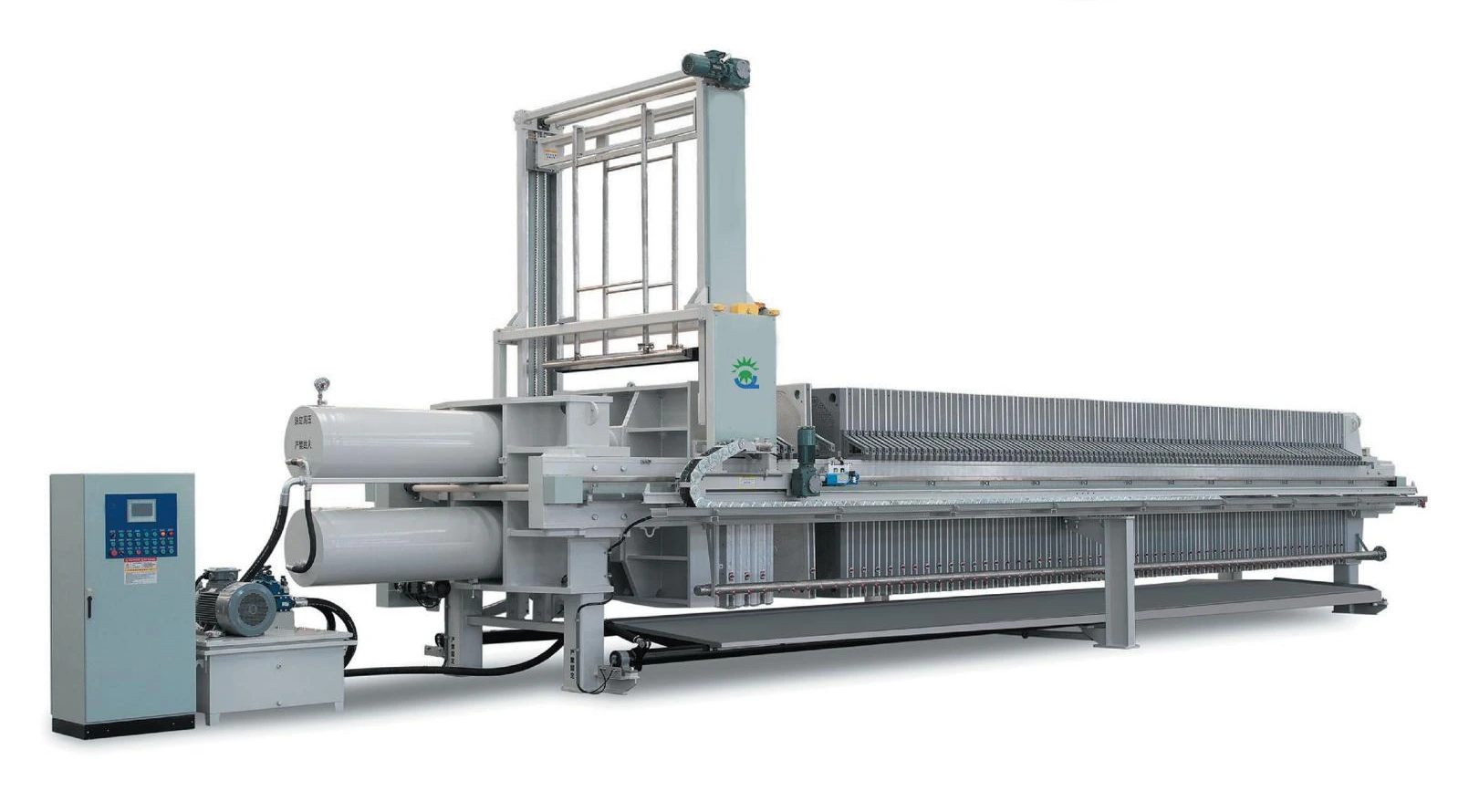
The frame supports the plate pack, closing assembly, piping, and guarding. Plates form the filtration chambers and provide filtrate channels; cloths separate solids from liquid and must match the plate geometry, attachment method, and slurry. A hydraulic closing unit or other approved closing arrangement applies the force required to hold the pack together. Its hydraulic pressure should be discussed separately from feed and squeeze pressures.
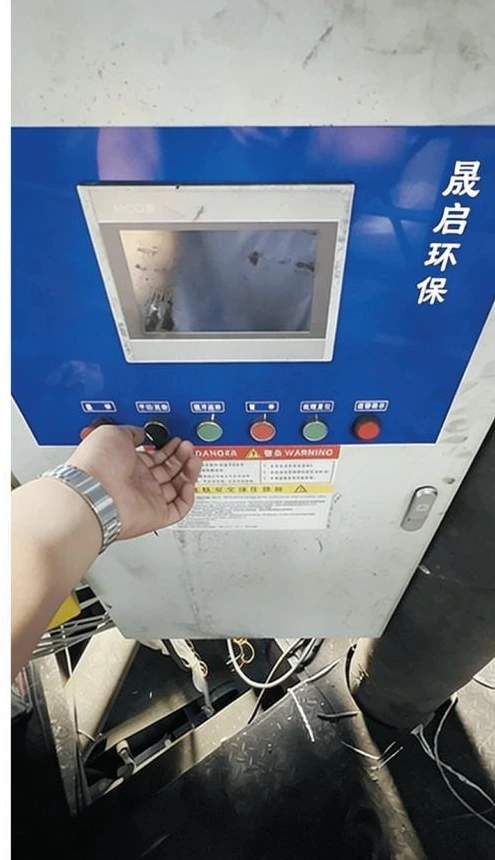
The automatic equipment layer can include a plate-shifting mechanism, position sensors, a control cabinet, a local operator interface, emergency-stop devices, valves, pump signals, and interlocks. These parts do not all belong on every configuration. Their function is to coordinate an agreed sequence and prevent a permitted action when a required condition is absent. The discharge arrangement may include a cake conveyor, cake breaker, collection container, or manual receiving area depending on cake behavior and site layout.
| Component or interface | Function and selection question |
|---|---|
| Plate pack and cloths | What chamber or membrane arrangement, cloth attachment, material, size, and sealing geometry suit the slurry? |
| Closing assembly | What closing method, travel, protection, and isolation procedure are required for the selected frame? |
| Plate-shifting or discharge mechanism | Can the cake release reliably, and what receiving equipment and guarding are needed? |
| Controls and sensors | Which positions, pressure signals, valve states, alarms, and manual approvals are required? |
| Utilities and interfaces | What power, air, water, pump signals, drainage, and downstream connections are available? |
Technical Specifications
The confirmed dimensional reference for Shengqi's filter plate range is 250–2000 mm, with 1000 mm and 1250 mm examples available for discussion. This range is a plate-series reference, not a promise that every automatic frame, cloth, chamber depth, or control package is available at every size. The selected plate size and pack depend on required filtration area, chamber volume, frame geometry, slurry behavior, installation limits, and the intended cycle.
| Specification field | Status and confirmation basis |
|---|---|
| Plate series reference | 250–2000 mm range; 1000 mm and 1250 mm examples confirmed for discussion |
| Plate type | Confirm chamber, membrane, or other specified arrangement from slurry and process objectives |
| Filtration area and chamber volume | Calculate from the selected plate, chamber depth, and pack; do not infer production capacity directly |
| Pressures | Confirm feed, optional squeeze, and hydraulic closing pressure separately for the proposed configuration |
| Automation scope | Confirm controlled movements, sensors, alarms, interlocks, manual approvals, and communication signals |
| Performance values | Confirm through material data, testing, and engineering review rather than a generic promise |
Available Configurations
Configuration should follow the job, not a preferred control label. Options to review include chamber or membrane plates, different cloth attachment arrangements, manual or coordinated plate movement, a local control panel, pump and valve signals, filtrate manifolds, guarding, and a cake receiving route. A conveyor or cake breaker can be considered when the discharged cake needs controlled transfer, but its suitability still depends on stickiness, lump size, moisture, and the downstream process.
- Plate arrangement: chamber or membrane, subject to slurry and cake objective review.
- Discharge: observed manual release, coordinated plate shifting, conveyor, breaker, bin, or another defined receiving method.
- Controls: local panel, sensors, alarms, interlocks, emergency stops, pump/valve signals, and optional plant communication.
- Site package: feed pump, filtrate piping, drains, guarding, platforms, lifting access, and utility connections as confirmed in scope.
Slurry Data Needed for Selection
Send the information available rather than estimating a value to make the form complete. State whether the requested feed rate is wet slurry, liquid flow, or dry solids, and include the unit and operating schedule. Explain the target: water recovery, solids handling, product recovery, cake transport, disposal, filtrate reuse, or another defined objective. If the target is a water-quality limit, identify the test method or receiving requirement; a filter press alone does not establish final treatment compliance.
Useful samples or test data include particle-size distribution, suspended and dissolved solids, viscosity, temperature, pH, abrasiveness, density, chemical compatibility, settling behavior, cake release, and whether the feed changes by batch. Also report existing pump details, available electrical supply, compressed air or water requirements, floor level, headroom, access route, receiving equipment, and the operator's expected role.
| Data group | Information to send |
|---|---|
| Material | Source, composition, solids basis, particle size, density, viscosity, temperature, pH, and abrasiveness |
| Objective | Cake handling, filtrate reuse, product recovery, discharge method, and any wash or squeeze requirement |
| Quantity | Wet slurry or dry-solids amount, unit, batch/continuous pattern, and hours per day |
| Existing equipment | Plate or press model, pump, cloth, valves, control signals, and operating observations |
| Site | Power, air/water, drainage, floor, headroom, lifting, access, environment, and downstream route |
Installation Requirements
Before delivery planning, confirm the floor and support arrangement, the space needed to open and service the plate pack, the route for lifting and replacing plates, headroom for the selected mechanism, and safe access to the control cabinet and isolation points. Leave a clear path for cake discharge and filtrate drainage. Do not size the room only around the frame length; the moving plate pack, guarding, piping, maintenance access, and receiving equipment also affect the layout.
The site should identify electrical supply, control voltage, grounding, cable routes, feed-pump interface, valve actuation, compressed air or water if required, filtrate and drain connections, wash-liquid connections if separately specified, and downstream cake handling. Provide the actual local standards and hazardous-area requirements before control and motor details are finalized. Installation and commissioning responsibilities should state who provides foundations, lifting, pipework, cabling, utilities, guarding checks, operator training, and performance acceptance.
- Provide a dimensioned layout showing frame, opening direction, service clearance, platform, lifting route, and cake receiving area.
- Confirm utilities and interfaces before fabrication: power, signals, pump, valves, drainage, air/water, and any plant PLC connection.
- Agree responsibility for foundations, piping, cabling, guarding, testing, training, and acceptance records.
- Plan maintenance isolation and verification points so operators never need to bypass a safety device.
Maintenance & Replacement Parts
Routine care begins with an inspection of cloth seating, plate sealing faces, filtrate outlets, hydraulic leaks, moving parts, sensors, guards, cable condition, and the discharge path. Record cycle observations instead of changing settings without evidence. A longer cycle can result from feed changes, cloth blinding, blocked channels, a partially filled chamber, a valve problem, or a control hold; the automatic label does not identify the cause by itself.
Cloths and plates are wear and process-contact parts. Before ordering a replacement plate, send the equipment nameplate, front and back photographs, side and handle details, length, width, thickness, chamber depth, feed and outlet hole positions, sealing profile, puller arrangement, squeeze connection if present, material, quantity, and operating conditions. Before ordering a replacement cloth, send the plate and attachment form, center or corner holes, neck and edge details, dimensions, fixing and stitching pattern, original cloth sample or clear photographs, and the difference sought between an original replacement and a process change.
For controls and mechanisms, identify the press model, component nameplate, alarm code, sensor position, wiring reference, and photographs. Stop the equipment and follow site isolation before inspection inside the guarded or hazardous area. Never open a press under pressure or perform electrical work while energized. Cleaning methods, including any chemical cleaning, must be selected for the cloth, plate, seals, slurry, and local safety procedure; Shengqi does not provide a universal chemical recipe.
| Part or check | Useful record for service or quotation |
|---|---|
| Filter cloth | Plate model, attachment, dimensions, material, seam/neck details, sample photos, slurry, and change objective |
| Filter plate | Nameplate, both faces, side/handles, dimensions, holes, sealing, chamber depth, material, and quantity |
| Sensors and controls | Cabinet and component labels, alarm history, wiring reference, position, and safe fault symptoms |
| Moving and hydraulic parts | Part identification, leak or wear location, photographs, cycle observation, and isolation confirmation |
Frequently Asked Questions
Does automatic mean the press can run without an operator?
No. Automation can coordinate defined movements and signals, but an operator remains responsible for pre-start checks, observation, abnormal-condition response, safe isolation, and maintenance release. The actual boundaries must be documented for the selected configuration.
Is an automatic filter press different from a membrane filter press?
They describe different aspects. Automatic refers to control and sequence tasks; membrane refers to a plate and squeezing arrangement. A membrane press can be configured with automation when the frame, utilities, controls, and slurry objective support it.
What plate sizes can be discussed?
The confirmed filter plate series reference is 250–2000 mm, with 1000 mm and 1250 mm examples. The applicable size, chamber, cloth, and frame must be confirmed for the specific model rather than assumed from the series range.
Can you state the capacity, pressure, cake moisture, or cycle time now?
Not responsibly without the plate arrangement, slurry data, test conditions, and control scope. Feed pressure, optional squeeze pressure, and hydraulic closing pressure are separate values, and filtration area is not a direct capacity promise.
What should we send for an automatic filter press quotation?
Send slurry source and data, wet or dry-solids quantity with units, target, schedule, temperature and pH, existing equipment information, power and utility details, layout constraints, cake receiving method, desired automation boundary, and photographs or drawings.
Can the press include cake washing or membrane squeezing?
They can be reviewed as separate process stages when justified. Specify wash route and collection, or membrane medium and pressure boundary, rather than assuming either feature is included because the press is automatic.
What is the safe response to a fault during automatic operation?
Use the documented stop and isolation procedure, keep people clear of moving and pressurized parts, and investigate only after the equipment is in a verified safe state. Do not open under pressure, work on energized equipment, or bypass an interlock.
How do we replace plates or cloths accurately?
Use the nameplate and dimensional evidence: plate faces, side and handles, length, width, thickness, chamber depth, holes, sealing and connections; for cloths also show attachment, neck, edges, stitching, original sample, and slurry conditions. Submit these for drawing or sample review before batch supply.