- 01Nameplate and equipment photos→
- 02Measured plate and port details→
- 03Drawing or sample review→
- 04Material and service confirmation→
- 05Approved configuration→
- 06Quotation and supply→
- 07Pre-installation inspection
The flow confirms fit before supply. It does not authorize opening a press under pressure or replace the customer’s site isolation, inspection and commissioning procedures.
When to Choose Replacement Filter Plates
Replacement plates are appropriate when a plate is cracked, warped, worn at the sealing edge, damaged around a feed or filtrate port, or no longer matches the working plate pack. They may also be considered when an existing press is being returned to service and the original plate information is incomplete. The replacement must suit the press closing arrangement, plate handles, plate thickness, chamber geometry, cloth arrangement and connection points.
Do not select only by a nominal plate dimension. Two plates with similar outside dimensions can have different recessed depths, port positions, sealing profiles or handle locations. A replacement plate should be released for manufacture only after the existing equipment and the requested operating conditions have been reviewed. If the requirement is a new geometry rather than a match, use the custom filter plates route instead.
- For a direct replacement, preserve the press frame interface and the existing plate-pack sequence unless an approved change is intended.
- For a material or process change, review slurry chemistry, temperature, abrasive content, cleaning method and pressure requirements together.
- If only the cloth is worn while the plate remains serviceable, compare replacement filter cloth options before replacing the plate.
- Never open a press under pressure; isolate the equipment and follow the site lockout and safety procedure before inspection.
| Decision point | Information to confirm |
|---|---|
| Direct match | Existing press model, nameplate, plate style, dimensions and port layout |
| Material change | Fluid chemistry, temperature, solids, cleaning practice and compatibility review |
| Design change | New chamber depth, sealing or port arrangement, with drawing and sample approval |
| Cloth-only issue | Plate condition, cloth attachment method and cloth replacement requirements |
What to Send for Identification
Start with the equipment nameplate and a complete view of the press. Then photograph one representative plate from the front, back and side. Include close views of both handle areas, the sealing perimeter, feed opening, filtrate outlets, corner holes, center hole if present, and any diaphragm or compression connection. Mark the measurement direction on photographs so that length, width and thickness are not confused.
If the plate pack contains more than one style, photograph each style separately and identify its position in the pack. A damaged plate should not be the only reference when its edges or ports are distorted. An intact plate, drawing or sample can provide a safer comparison.
- Equipment brand and model from the nameplate, plus the number of plates currently installed.
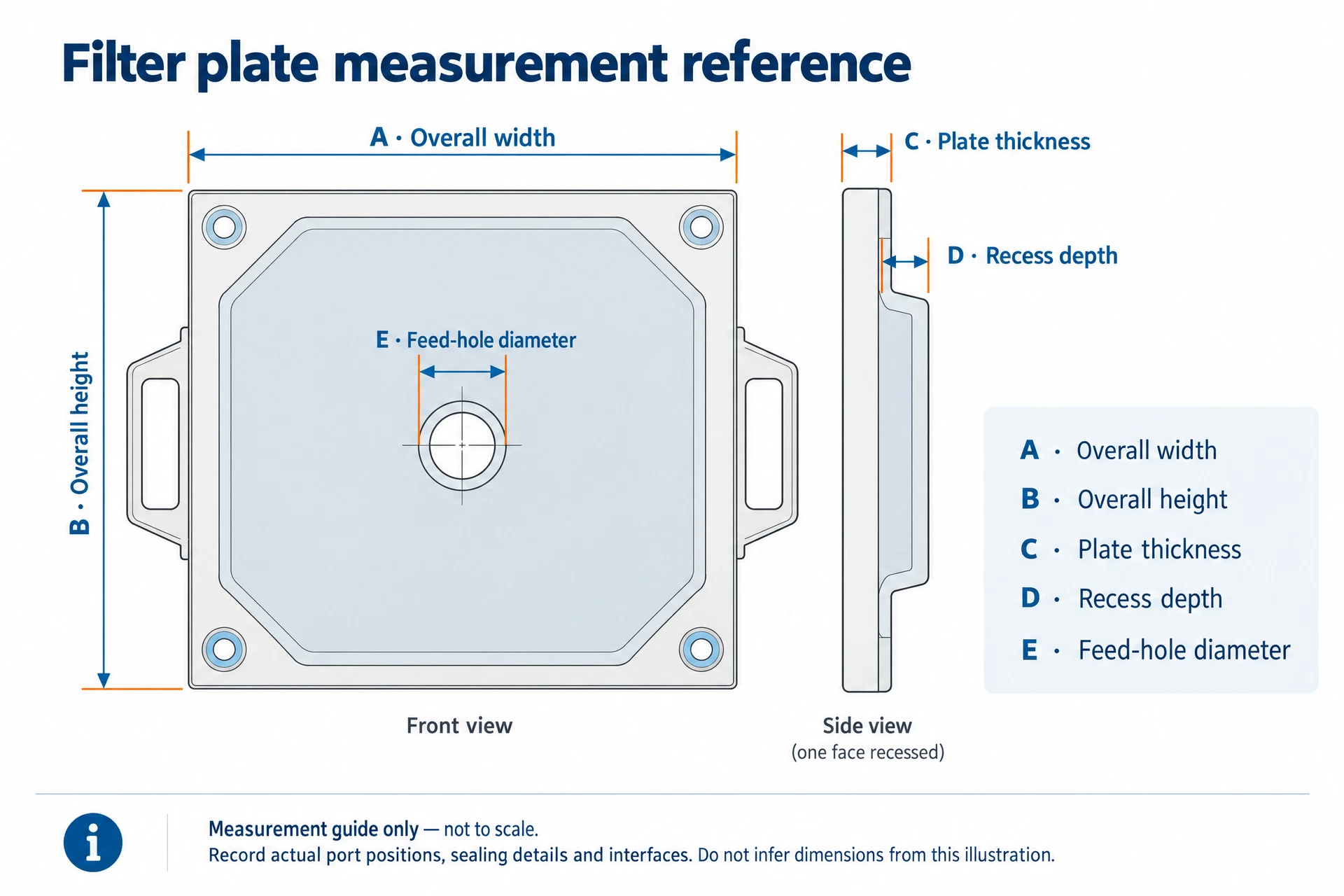
- Plate length, width and overall thickness; measure at more than one location when warping is suspected.
- Filter chamber depth or recessed depth, sealing dimensions and the position of plate handles.
- Feed and filtrate port diameter, center distance, corner-hole pattern and any special connections.
- Plate material, cloth material, slurry name, solids description, temperature, pH or chemical exposure, and cleaning method.
- Required quantity, delivery destination, operating urgency and whether an original sample can be supplied.
| Photograph | Required view | Why it matters |
|---|---|---|
| Nameplate | Readable full image | Identifies the installed press reference |
| Front and back | Plate face square to camera | Shows recess, ports and surface arrangement |
| Side and edge | Thickness and sealing edge | Checks profile, wear and warping |
| Handles and interfaces | Both ends plus connection close-up | Checks plate movement and process connections |
Measurement and Matching Review
Use a clean, stable plate or a verified drawing as the primary reference. Record units beside every value and note whether a dimension is nominal, measured, or taken from a drawing. The measurement guide provides a structured checklist for plate and cloth details. Shengqi then compares the submitted information against the requested replacement configuration and identifies conflicts before quotation or production.
Shengqi has confirmed a digital filter plate series covering 250–2000 mm, with 1000 mm and 1250 mm examples available in the reference material. This range is a series reference, not a promise that every size, thickness, chamber or interface fits every press. The applicable size and configuration must be confirmed against the equipment information, drawings, sample and service conditions.
- Separate plate area and chamber volume in the discussion; neither alone establishes actual throughput.
- Separate feed pressure, squeeze pressure and hydraulic-system pressure; do not infer one from another.
- Confirm whether the plate is recessed, membrane, CGR or another arrangement before matching cloth attachment and ports.
- Check whether the requested plate must support a diaphragm connection, washing path or special filtrate collection route.
- Treat dimensions as a controlled record: recheck critical values before approving a batch.
Drawing, Sample and Supply Process
The practical sequence is identification first, technical review second, and supply confirmation third. Andy can coordinate the information review for Shandong Shengqi Environmental Protection Equipment Co., Ltd. A drawing or sample is especially important when the nameplate is unreadable, the plate has been modified, or the request involves a different material or sealing arrangement.
After the configuration is agreed, the final record should state the approved dimensions, material, port layout, sealing details, cloth interface, quantity and any exclusions. Inspect the delivered plates before installation. Compare one plate with the approved record, check the sealing edge and ports, and confirm that the press is isolated and safe before fitting the plate pack.
| Step | Customer action | Review outcome |
|---|---|---|
| 1. Identify | Send nameplate, photos, dimensions and operating notes | Initial compatibility questions |
| 2. Clarify | Provide drawing, intact sample or missing measurements | Controlled technical configuration |
| 3. Confirm | Approve the reviewed plate and quantity | Quotation and supply basis |
| 4. Receive | Inspect plate details before installation | Fit check and installation record |
Maintenance and Replacement Boundaries
Keep plate faces, sealing edges and ports free of hardened deposits. Use a cleaning method compatible with the plate and cloth materials; do not apply a generic chemical recipe without checking the process fluid, material compatibility and site safety requirements. Inspect for cracks, deformation, edge damage, blocked ports and cloth attachment problems during an approved shutdown. Plate replacement does not correct a pump, slurry, cloth, closing-force or alignment problem by itself.
For installation, follow the press manufacturer’s sequence and the site’s isolation procedure. A qualified person should verify that the plate pack closes evenly and that all connections are correctly routed before operation. Contact Andy through WhatsApp +86 15116183980 or lkvicky2003@gmail.com with the page details and attachments.
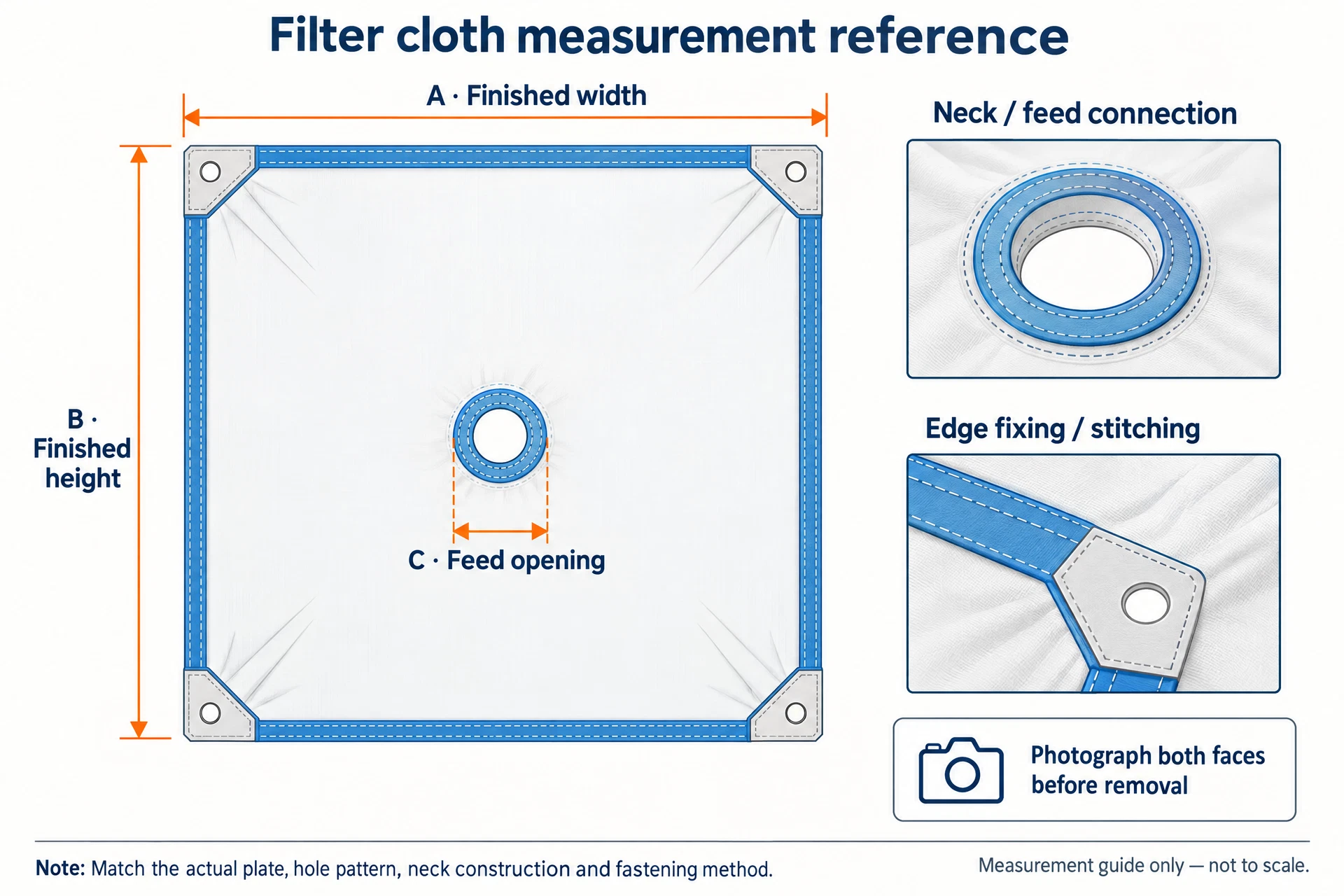
Plate & cloth measurement references
These illustrations are measurement guides only, not to scale and not manufacturing drawings. Record dimensions in millimetres from the actual part. Measure only after equipment has been safely isolated, depressurized and secured.
Frequently Asked Questions
Can you match a plate from photographs alone?
Photographs are useful for an initial review, but a reliable match normally also needs the equipment nameplate, measured dimensions, port layout, sealing details and service information. An intact sample or drawing is recommended when the plate is worn or modified.
Do the 250–2000 mm series references fit every filter press?
No. The confirmed series range and the 1000 mm and 1250 mm examples are reference information only. The applicable plate must be checked against the installed press, thickness, chamber, handles, ports, sealing arrangement, material and operating conditions.
Should I replace the whole plate pack when one plate is damaged?
Not automatically. First review the damage, plate style, age and condition of the remaining pack. Mixing plates can affect the sequence and sealing, so any partial replacement must be checked against the existing configuration before approval.
Can you supply a different material or a new port layout?
A material or layout change can be reviewed as a technical configuration or custom plate request. Provide the fluid, temperature, pH or chemical exposure, solids, cleaning practice, drawing and sample details so compatibility and fit can be assessed.