- 01Nameplate and photos→
- 02Measured plate and interfaces→
- 03Drawing or sample review→
- 04Material and slurry check→
- 05Specification approval→
- 06Quotation and production planning
The flow confirms mechanical fit before production. Filtration testing may still be required for a process change; plate review does not by itself establish pressure, capacity, cake moisture or water-quality performance.
When Custom Filter Plates Are Appropriate
A custom plate review is useful when a standard catalogue description does not identify the correct length, width, thickness, chamber depth, handle arrangement, feed opening or filtrate route. It is also appropriate when a replacement must match an installed plate set, when the press has been modified, or when the slurry and cleaning conditions require a different material or sealing arrangement.
- Use custom review for a non-standard plate, a modified press or an exact replacement match.
- Use the existing plate manufacturer and model information whenever it is available.
- Separate a plate geometry change from a process change; a new plate does not by itself guarantee clearer filtrate or drier cake.
- Send a sample or drawing before approving batch production.
| Situation | Information needed before a recommendation |
|---|---|
| Exact replacement | Plate photos, nameplate, measured dimensions, hole positions and sealing details |
| Modified press | Press model, closing and pulling arrangement, stack layout and interface drawings |
| New plate arrangement | Slurry description, cloth plan, filtration objective and test or sample information |
| Material change | Temperature, pH, solids, cleaning practice and contact-material requirements |
What the Custom Plate Specification Covers
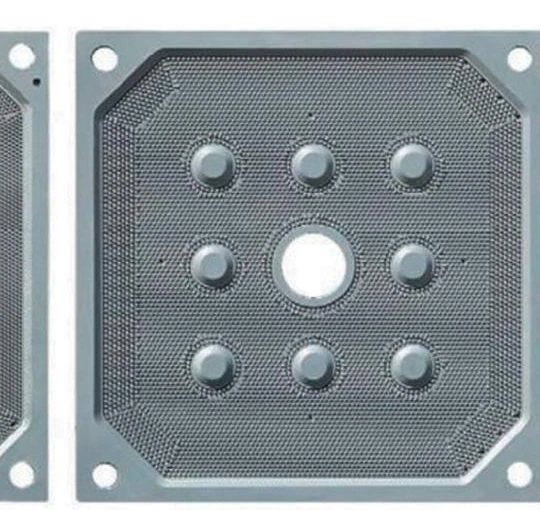
The review starts with the plate envelope and the interfaces that control fit. The requested plate length, width and thickness are checked with the chamber depth, sealing land and installed cloth. Feed and filtrate openings are recorded by position, diameter or shape as applicable, rather than inferred from the front photograph. Handle locations and dimensions are checked against the side rails or plate-pulling equipment.
| Feature to confirm | Why it affects the order |
|---|---|
| Length, width and thickness | Controls stack fit, closing position and cloth alignment |
| Chamber depth or recess | Affects the available cake space; it is not a direct production guarantee |
| Feed and filtrate holes | Must align with the press manifold, cloth and internal flow path |
| Sealing face and gasket | Controls plate-to-plate contact and leakage risk when correctly fitted |
| Handles and pull points | Must match the plate shifting or unloading arrangement |
| Material and temperature or chemical exposure | Defines compatibility checks for the intended slurry and cleaning conditions |
Information to Submit for Review
A useful submission combines identification, measurement and operating context. Photograph the plate face, reverse, both sides, sealing edge, handles, feed opening, filtrate openings and any marks or damage. Include a clear press nameplate and a ruler or tape measure in close-up images. If the plate cannot be removed safely, state that limitation rather than opening the press under pressure.
- Press nameplate and model identification.
- Front, back, side, handle, sealing and hole-position photographs.
- Measured length, width, overall thickness and chamber or recess depth.
- Feed, corner and centre opening positions and dimensions where present.
- Plate material, quantity, cloth style and attachment method.
- Slurry description, temperature, pH, solids information, cleaning practice and intended duty.
- Existing drawing, plate sample or marked-up sketch, if available.
Review, Sample Confirmation and Production Flow
| Step | Customer and supplier decision |
|---|---|
| 1. Identify | Submit the press nameplate, existing plate type and quantity |
| 2. Measure | Record the envelope, recess, holes, sealing faces and handles |
| 3. Compare | Check the plate, cloth, manifold and pulling arrangement as one set |
| 4. Resolve | Confirm missing dimensions, material compatibility and operating conditions |
| 5. Sample or drawing | Approve the physical or documented reference before batch manufacture |
| 6. Order review | Confirm quantity, inspection points and quotation scope |
Known Series References and Selection Boundaries
The confirmed reference range for Shengqi filter plate discussions is a nominal series from 250 to 2000 mm, with 1000 mm and 1250 mm examples available as reference points. These examples do not mean that every press, chamber depth, hole pattern or material is available in every size. They also do not establish a fixed filtration area, chamber volume, feed pressure or processing output for an unconfirmed assembly.
Use the size range as a starting point for the review, then confirm the actual plate drawing and press interfaces. The final selection remains subject to the plate type, cloth, sealing arrangement, slurry, temperature, pH and machine configuration.
- Confirmed reference series: 250–2000 mm nominal range.
- Examples confirmed for discussion: 1000 mm and 1250 mm.
- Still to confirm: exact model, plate type, thickness, chamber depth, holes, handles, material and quantity.
- Do not use a nominal size alone to calculate capacity or promise production performance.
Fit, Care and Related Parts
- Stop, isolate and follow the equipment procedure before inspection; never open a press under pressure or repair energized equipment.
- Check cloth attachment and hole alignment before tightening or cycling the stack.
- Record leakage location, plate position and operating conditions for troubleshooting.
- Use compatible cleaning practices confirmed for the plate material and slurry; do not apply a generic chemical formula.
Frequently Asked Questions
Can Shengqi make a plate from a customer drawing?
Yes, a drawing can be used for review, but it should be checked against the press nameplate, a physical plate or clear photographs, cloth attachment and operating conditions. Missing dimensions and interfaces must be confirmed before production is approved.
What is the confirmed filter plate size range?
The confirmed reference series is 250–2000 mm, with 1000 mm and 1250 mm examples. The applicable size, plate type and interfaces remain subject to model-specific review; the range is not a promise that every configuration is available in every size.
Can a custom plate increase my filter press capacity?
A plate change can alter chamber geometry or fit, but capacity depends on the complete press, slurry, cloth, cycle and operating method. Shengqi will not infer processing output from nominal plate dimensions alone.
What photographs are most useful?
Send the press nameplate, plate front and back, both sides, handles, sealing edge, feed and filtrate openings, cloth attachment and any damage. Include a ruler or tape measure and one wider image showing how the plate sits in the press.
How do I request a quotation?
Send the measurements, photographs, drawing or sample information, quantity and slurry conditions to Andy at lkvicky2003@gmail.com or WhatsApp +86 15116183980. Include the desired plate type and whether the request is an exact replacement or a design change.